


Page 437 - The City and Guilds Textbook: Plumbing Book 1 for the Level 3 Apprenticeship (9189), Level 2 Technical Certificate (8202) and Level 2 Diploma (6035)
P. 437
Chapter 6 Hot water systems


                   be a source of frustration within systems running at high pressures because
                   of the noise it can generate. Incorrect clipping distances and, often, lack of
                   clips and supports can put a strain on the fittings and cause the pipework
                   to reverberate throughout the installation, even causing fitting failure and
                   leakage. To prevent these occurrences, the installation should be checked as
                   it progresses and any deficiencies brought to the attention of the installing
                   engineer. Upon completion, the system should be visually checked before
                   flushing and commissioning begins.
                ●  Leakage: water causes a huge amount of damage to a building and can
                   even compromise the building structure. Leakage from pipework, if left
                   undetected, causes damp, mould growth and an unhealthy atmosphere. It
                   is, therefore, important that leakage is detected and cured at a very early
                   stage in the system’s life. It is almost impossible to ensure that every joint
                   on every system installed is leak free. Manufacturing defects on fittings and
                   equipment, as well as damage, sometimes cause leaks. Leakage due to badly
                   jointed fittings and poor installation practice are much more common,
                   especially on large systems where literally thousands of joints have to be
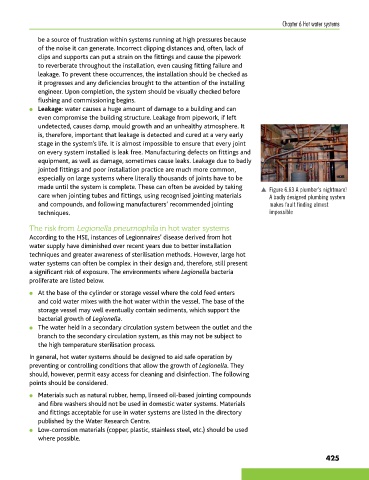
                   made until the system is complete. These can often be avoided by taking   p  Figure 6.63 A plumber’s nightmare!
                   care when jointing tubes and fittings, using recognised jointing materials   A badly designed plumbing system
                   and compounds, and following manufacturers’ recommended jointing           makes fault finding almost
                   techniques.                                                                impossible

                The risk from Legionella pneumophila in hot water systems
                According to the HSE, instances of Legionnaires’ disease derived from hot
                water supply have diminished over recent years due to better installation
                techniques and greater awareness of sterilisation methods. However, large hot
                water systems can often be complex in their design and, therefore, still present
                a significant risk of exposure. The environments where Legionella bacteria
                proliferate are listed below.

                ●  At the base of the cylinder or storage vessel where the cold feed enters
                   and cold water mixes with the hot water within the vessel. The base of the
                   storage vessel may well eventually contain sediments, which support the
                   bacterial growth of Legionella.
                ●  The water held in a secondary circulation system between the outlet and the
                   branch to the secondary circulation system, as this may not be subject to
                   the high temperature sterilisation process.

                In general, hot water systems should be designed to aid safe operation by
                preventing or controlling conditions that allow the growth of Legionella. They
                should, however, permit easy access for cleaning and disinfection. The following
                points should be considered.
                ●  Materials such as natural rubber, hemp, linseed oil-based jointing compounds
                   and fibre washers should not be used in domestic water systems. Materials
                   and fittings acceptable for use in water systems are listed in the directory
                   published by the Water Research Centre.
                ●  Low-corrosion materials (copper, plastic, stainless steel, etc.) should be used
                   where possible.


                                                                                                                425


        9781510416482.indb   425                                                                                    29/03/19   9:02 PM

