


Page 585 - The City and Guilds Textbook: Plumbing Book 1 for the Level 3 Apprenticeship (9189), Level 2 Technical Certificate (8202) and Level 2 Diploma (6035)
P. 585
Chapter 9 Sanitation systems

                Sinks
                                                                                                 INDUSTRY TIP
                Sinks are appliances typically fitted in a kitchen or utility room. The ideal sink
                has to be hardwearing and robust enough to be able to withstand the abuse it is   Stainless steel sinks will
                likely to receive. There are several different types, as described here.    require bonding to the
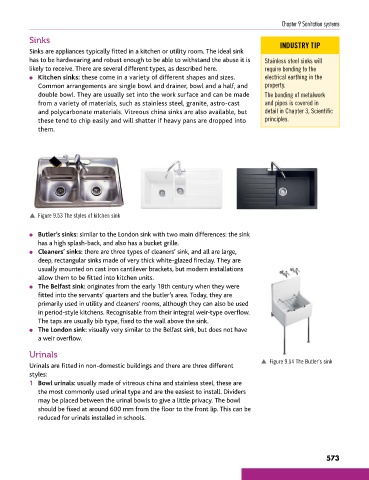
                ●  Kitchen sinks: these come in a variety of different shapes and sizes.    electrical earthing in the
                   Common arrangements are single bowl and drainer, bowl and a half, and    property.
                   double bowl. They are usually set into the work surface and can be made   The bonding of metalwork
                   from a variety of materials, such as stainless steel, granite, astro-cast   and pipes is covered in
                   and polycarbonate materials. Vitreous china sinks are also available, but   detail in Chapter 3, Scientific
                   these tend to chip easily and will shatter if heavy pans are dropped into   principles.
                   them.


                p  Figure 9.53 The styles of kitchen sink


                ●  Butler’s sinks: similar to the London sink with two main differences: the sink
                   has a high splash-back, and also has a bucket grille.
                ●  Cleaners’ sinks: there are three types of cleaners’ sink, and all are large,
                   deep, rectangular sinks made of very thick white-glazed fireclay. They are
                   usually mounted on cast iron cantilever brackets, but modern installations
                   allow them to be fitted into kitchen units.
                ●  The Belfast sink: originates from the early 18th century when they were
                   fitted into the servants’ quarters and the butler’s area. Today, they are
                   primarily used in utility and cleaners’ rooms, although they can also be used
                   in period-style kitchens. Recognisable from their integral weir-type overflow.
                   The taps are usually bib type, fixed to the wall above the sink.
                ●  The London sink: visually very similar to the Belfast sink, but does not have
                   a weir overflow.

                Urinals
                                                                                           p  Figure 9.54 The Butler’s sink
                Urinals are fitted in non-domestic buildings and there are three different
                styles:
                1  Bowl urinals: usually made of vitreous china and stainless steel, these are
                   the most commonly used urinal type and are the easiest to install. Dividers
                   may be placed between the urinal bowls to give a little privacy. The bowl
                   should be fixed at around 600 mm from the floor to the front lip. This can be
                   reduced for urinals installed in schools.


                                                                                                                573


        9781510416482.indb   573                                                                                    29/03/19   9:06 PM

