


Page 587 - The City and Guilds Textbook: Plumbing Book 1 for the Level 3 Apprenticeship (9189), Level 2 Technical Certificate (8202) and Level 2 Diploma (6035)
P. 587
Chapter 9 Sanitation systems

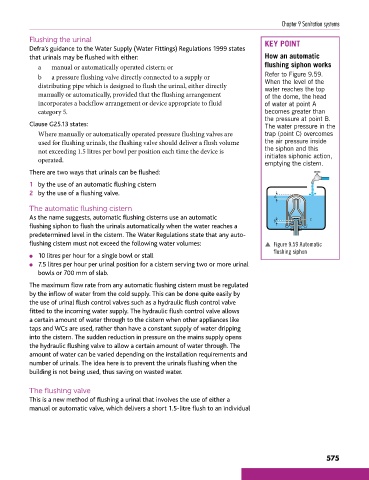
                Flushing the urinal                                                         KEY POINT
                Defra’s guidance to the Water Supply (Water Fittings) Regulations 1999 states
                that urinals may be flushed with either:                                    How an automatic
                   a   manual or automatically operated cistern; or                         flushing siphon works
                   b   a pressure flushing valve directly connected to a supply or          Refer to Figure 9.59.
                                                                                            When the level of the
                   distributing pipe which is designed to flush the urinal, either directly   water reaches the top
                   manually or automatically, provided that the flushing arrangement        of the dome, the head
                   incorporates a backflow arrangement or device appropriate to fluid       of water at point A
                   category 5.                                                              becomes greater than
                                                                                            the pressure at point B.
                Clause G25.13 states:                                                       The water pressure in the
                   Where manually or automatically operated pressure flushing valves are    trap (point C) overcomes
                   used for flushing urinals, the flushing valve should deliver a flush volume   the air pressure inside
                   not exceeding 1.5 litres per bowl per position each time the device is   the siphon and this
                                                                                            initiates siphonic action,
                   operated.                                                                emptying the cistern.
                There are two ways that urinals can be flushed:

                1  by the use of an automatic flushing cistern
                2  by the use of a flushing valve.
                                                                                               A
                The automatic flushing cistern
                As the name suggests, automatic flushing cisterns use an automatic             B           C
                flushing siphon to flush the urinals automatically when the water reaches a
                predetermined level in the cistern. The Water Regulations state that any auto-
                flushing cistern must not exceed the following water volumes:               p  Figure 9.59 Automatic
                                                                                               flushing siphon
                ●  10 litres per hour for a single bowl or stall
                ●  7.5 litres per hour per urinal position for a cistern serving two or more urinal
                   bowls or 700 mm of slab.
                The maximum flow rate from any automatic flushing cistern must be regulated
                by the inflow of water from the cold supply. This can be done quite easily by
                the use of urinal flush control valves such as a hydraulic flush control valve
                fitted to the incoming water supply. The hydraulic flush control valve allows
                a certain amount of water through to the cistern when other appliances like
                taps and WCs are used, rather than have a constant supply of water dripping
                into the cistern. The sudden reduction in pressure on the mains supply opens
                the hydraulic flushing valve to allow a certain amount of water through. The
                amount of water can be varied depending on the installation requirements and
                number of urinals. The idea here is to prevent the urinals flushing when the
                building is not being used, thus saving on wasted water.

                The flushing valve
                This is a new method of flushing a urinal that involves the use of either a
                manual or automatic valve, which delivers a short 1.5-litre flush to an individual


                                                                                                                575


        9781510416482.indb   575                                                                                    29/03/19   9:07 PM

