


Page 602 - The City and Guilds Textbook: Plumbing Book 1 for the Level 3 Apprenticeship (9189), Level 2 Technical Certificate (8202) and Level 2 Diploma (6035)
P. 602
The City & Guilds Textbook: Plumbing Book 1
Table 9.7 The advantages and disadvantages of the combined system
Advantages Disadvantages
Maintenance of the drains is much easier All discharge must pass through the sewage
It is a cheaper system to install treatment plant, which is expensive and
It is impossible to connect to the wrong drain difficult to handle during heavy rainfall
All drains are flushed out when it rains
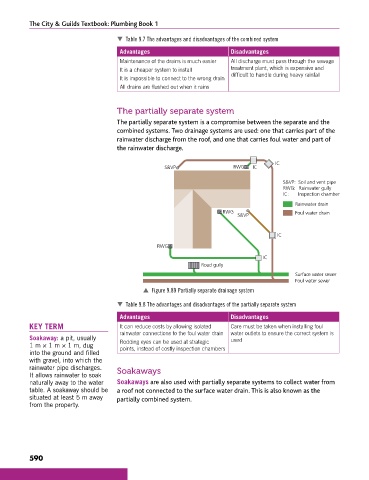
The partially separate system
The partially separate system is a compromise between the separate and the
combined systems. Two drainage systems are used: one that carries part of the
rainwater discharge from the roof, and one that carries foul water and part of
the rainwater discharge.
IC
S&VP RWG IC
S&VP: Soil and vent pipe
RWG: Rainwater gully
IC: Inspection chamber
Rainwater drain
RWG Foul water drain
S&VP
IC
RWG
IC
Road gully
Surface water sewer
Foul water sewer
p Figure 9.89 Partially separate drainage system
Table 9.8 The advantages and disadvantages of the partially separate system
Advantages Disadvantages
KEY TERM It can reduce costs by allowing isolated Care must be taken when installing foul
rainwater connections to the foul water drain water outlets to ensure the correct system is
Soakaway: a pit, usually used
1 m × 1 m × 1 m, dug Rodding eyes can be used at strategic
points, instead of costly inspection chambers
into the ground and filled
with gravel, into which the
rainwater pipe discharges. Soakaways
It allows rainwater to soak
naturally away to the water Soakaways are also used with partially separate systems to collect water from
table. A soakaway should be a roof not connected to the surface water drain. This is also known as the
situated at least 5 m away partially combined system.
from the property.
590
9781510416482.indb 590 29/03/19 9:07 PM

