


Page 645 - The City and Guilds Textbook: Plumbing Book 1 for the Level 3 Apprenticeship (9189), Level 2 Technical Certificate (8202) and Level 2 Diploma (6035)
P. 645
Chapter 10 Domestic fuel systems

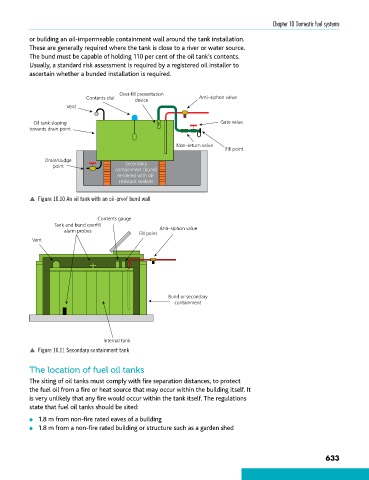
                or building an oil-impermeable containment wall around the tank installation.
                These are generally required where the tank is close to a river or water source.
                The bund must be capable of holding 110 per cent of the oil tank’s contents.
                Usually, a standard risk assessment is required by a registered oil installer to
                ascertain whether a bunded installation is required.


                                             Over-fill preventation
                                  Contents dial   device               Anti–siphon value
                            Vent


                 Oil tank sloping                                             Gate value
                towards drain point

                                                               Non–return value
                                                                               Fill point
                     Drain/sludge
                       point                   Secondary
                                            containment (bund)
                                            rendered with oil-
                                             resistant sealant


                p  Figure 10.10 An oil tank with an oil-proof bund wall


                                      Contents gauge
                        Tank and bund overfill
                           alarm probes            Fill point  Anti–siphon value
                 Vent


                                                             Bund or secondary
                                                               containment


                                        Internal tank
                p  Figure 10.11 Secondary containment tank


                The location of fuel oil tanks

                The siting of oil tanks must comply with fire separation distances, to protect
                the fuel oil from a fire or heat source that may occur within the building itself. It
                is very unlikely that any fire would occur within the tank itself. The regulations
                state that fuel oil tanks should be sited:
                l  1.8 m from non-fire rated eaves of a building
                l  1.8 m from a non-fire rated building or structure such as a garden shed


                                                                                                                633


        9781510416482.indb   633                                                                                    29/03/19   9:08 PM

