


Page 647 - The City and Guilds Textbook: Plumbing Book 1 for the Level 3 Apprenticeship (9189), Level 2 Technical Certificate (8202) and Level 2 Diploma (6035)
P. 647
Chapter 10 Domestic fuel systems
Table 10.5 The distances from buildings and structures for LPG storage tanks
Maximum LPG capacity of any single Minimum separation distances of all
vessel in a group vessels in a group
LPG capacity Typical water LPG From buildings, boundary, Between
(tonnes) capacity capacity property line or fixed source vessels
(litres) (tonnes) of ignition (m)
Without a fire With a fire
wall (m) wall (m)
0.05 to 0.25 150 to 500 0.8 2.5 0.3 1
> 0.25 to 1.1 > 500 to 2500 3.5 3 1.5 1
> 1.1 to 4 > 2500 to 9000 12.5 7.5 4 1
Ventilation and conditions around the LPG storage tank KEY POINT
There should be plenty of room around the tank to allow good air circulation so Further guidance on
that pockets of the heavier-than-air gas cannot build up around it should a leak location and spacing for
occur. The area should also be kept free of rubbish and weeds, and any grass vessels and requirements
should be kept short. concerning fire wall
provision is available
Protection against impact in LP Gas Association
COP 1 Part 1, and for
Tanks and their associated pipework should not be located in areas where motor buried vessels in LP Gas
traffic is likely. However, if this is unavoidable, then a suitable protective barrier Association COP 1 Part 4.
should be installed in the form of either bollards or crash barriers. A security
fence is not suitable since this is unlikely to offer the required protection.
The LPG gas cylinder option
It is often a good idea to start using LPG with an LPG cylinder installation
until the exact usage of the installation is known. Large bulk storage tank
installations become viable only when usage exceeds 2000–2500 litres per year.
The average bulk storage tank user uses around 2300 litres per year.
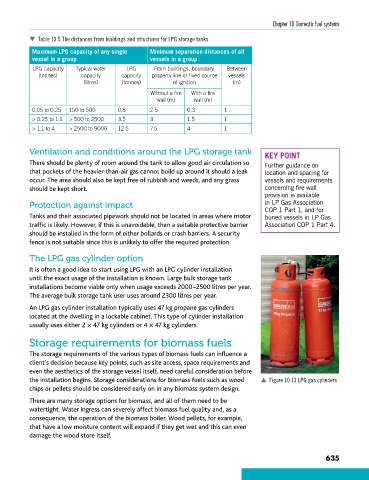
An LPG gas cylinder installation typically uses 47 kg propane gas cylinders
located at the dwelling in a lockable cabinet. This type of cylinder installation
usually uses either 2 × 47 kg cylinders or 4 × 47 kg cylinders.
Storage requirements for biomass fuels
The storage requirements of the various types of biomass fuels can influence a
client’s decision because key points, such as site access, space requirements and
even the aesthetics of the storage vessel itself, need careful consideration before
the installation begins. Storage considerations for biomass fuels such as wood p Figure 10.13 LPG gas cylinders
chips or pellets should be considered early on in any biomass system design.
There are many storage options for biomass, and all of them need to be
watertight. Water ingress can severely affect biomass fuel quality and, as a
consequence, the operation of the biomass boiler. Wood pellets, for example,
that have a low moisture content will expand if they get wet and this can even
damage the wood store itself.
635
9781510416482.indb 635 29/03/19 9:08 PM

