


Page 309 - APPLIED PROCESS DESIGN FOR CHEMICAL AND PETROCHEMICAL PLANTS, Volume 1, 3rd Edition
P. 309
Mechanical Separations                                     279


                                                                                -------Q


            A.  Direct Interception          B. Sieving                          C.  Bridging
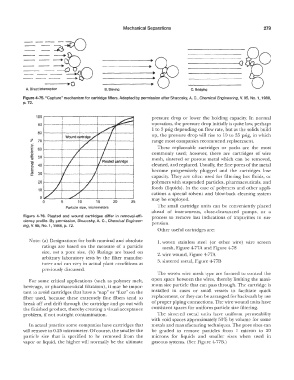
           Figure 4-75.  "Capture" mechanism for cartridge filters. Adapted by permission after Shucosky,  A.  C., Chemical  Engineering, V.  95, No. 1, 1988,
           p.  72.


                100                                              pressure  drop  or lower the  holding  capacity.  In  normal
                 90                                              operation, the pressure drop initially is quite low,  perhaps
                                                                 1  to 3 psig depending on flow rate,  but as the solids build
                 80
                                                                 up,  the  pressure  drop will  rise  to  10 LO  35  psig,  in which
              ,!?.
              0   70                                             range most companies recommend replacement.
              �                                                    These  replaceable  cartridges  or  packs  are  the  most
              c:
              ·u   60                                            commonly  used;  however,  there  are  cartridges  of wire
              Q)
              :E   50
              (!)                                                mesh,  sintered  or porous  metal  which  can  be  removed,
              'lij
              >  40                                              cleaned, and replaced. Usually,  the fine pores of the metal
              0
              E                                                  become  progressively  plugged  and  the  cartridges  lose
              Q)
              0:   30
                                                                 capacity.  They  are  often  used for  filtering  hot fluids,  or
                 20                                              polymers with suspended particles,  pharmaceuticals,  and
                 10                                              foods  (liquids).  In  the  case of polymers  and  other appli-
                                                                 cations  a  special  solvent and  blow-back  cleaning  system
                                                                 may  be employed.
                             Particle size,  micrometers           The  small  cartridge  units  can  be  conveniently  placed
                                                                 ahead  of  instruments,  close-clearanced  pumps,  or  a
           Figure  4-76.  Pleated  and  wound  cartridges  differ  in  removal-effi-   process  to  remove  last  indications  of impurities  in  sus-
           ciency profile.  By permission,  Shucosky,  A.  C., Chemical Engineer-   pension.
           ing,  V.  95,  No. 1, 1988,  p.  72.
                                                                   Other useful cartridges are:
             Note:  (a)  Designations  for both  nominal  and absolute   1. woven  stainless  steel  ( or  other  wire)  wire  screen
                   ratings  are  based  on  the  measure  of a  particle   mesh, Figure 4-77A and Figure  4-78
                   size,  not  a  pore  size.  (b)  Ratings  are  based  on   2. wire wound,  Figure 4-77 A
                   arbitrary  laboratory  tests  by  the  filter manufac-   3.  sintered metal, Figure 4-77B
                   turer and can vary  in  actual  plant conditions  as
                   previously  discussed.
                                                                   The woven  wire  mesh  type  are  formed  to  control  the
             For some  critical  applications  (such  as  polymer melt,   open space between the wires,  thereby limiting the maxi-
           beverage,  or pharmaceutical  filtration), it may  be  impor-   mum size particle that can pass through.  The cartridge is
           tant to avoid cartridges  that have a  "nap" or "fuzz" on the   installed  in  cases  or  small  vessels  Lo  facilitate  quick
           fiber  used,  because  these  extremely  fine  fibers  tend  to   replacement,  or they can be arranged for backwash by use
           break off and drift through  the cartridge and go out with   of  proper piping connections.  The wire wound uni ts have
           the finished product,  thereby creating a visual acceptance   consistent spaces for uniform particle size filtering.
           problem,  if not outright contamination.                The  sintered  metal  units  have  uniform  permeability
                                                                 with void spaces  approximately 50%  by volume for some
             In actual practice some companies have cartridges that   metals and manufacturing techniques.  The pore sizes can
           will remove to 0.25 micrometer.  Of course, the smaller the   be  graded  to  remove  particles  from  1  micron  to  20
           particle  size  that  is  specified  to  be  removed  from  the   microns  for  liquids  and  smaller  sizes  when  used  in
           vapor or liquid,  the  higher will  normally  be  the ultimate   gaseous systems.  (See Figure 4-778.)

