


Page 307 - APPLIED PROCESS DESIGN FOR CHEMICAL AND PETROCHEMICAL PLANTS, Volume 1, 3rd Edition
P. 307
Mechanical  Separations                                    277

                                                             some applications,  actual  testing in  the plant using plant
                                                             fluid streams can  be  the most conclusive.  This  plant test-
                                                             ing is not necessary for every situation because the manu-
                                                             facturer has  large  data files  to  often  aid in  a  good  selec-
                                                             tion.  Generally the ability to collect solids at low flow rates
                                                             is greater for the wound filter.
                                                               Because the suspended particles are "captured" by dif-
                                                             ferent  physical  mechanisms  depending  on  the  particle
                                                             size,  shape,  density,  and  concentration,  all  cartridges  do
                                                             not perform the same. The "capture" may be by  ( 1) direct
                                                             interception,  (2)  sieving,  and/or  (3)  bridging  [39].  (See
                                                             Figure  4-75.)  The  cartridges  from  one  manufacturer are
                                                             generally  consistent  in  performance;  however,  all  car-
                                                             tridges  from  just  any  manufacturer  may  not  be  inter-
                                                             changeable in performance.
                                                               The micron ratings of a cartridge are intended to indi-
                                                             cate the smallest particle that will be retained by the pores
                                                             of  the  filter  element.  Often  a  "rough-cut"  pre-filter  is
                                                             installed ahead of a final  or "polishing" filter in  order to
                                                             increase  the  life  of  the  final  unit.  Unfortunately,  the
                                                             method  for determining  the  micron  rating  is  not a  uni-
                                                             versal standard between manufacturers.  Thus, one manu-
                                                             facturer's "50 micron" filter may not perform the same as
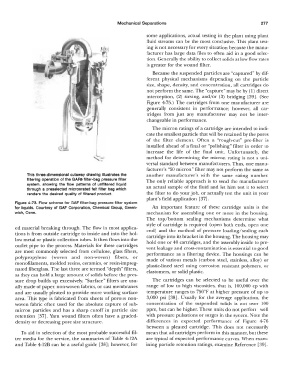
            This three-dimensional  cutaway drawing  Illustrates the   another  manufacturer's  with  the  same  rating  number.
            filtering operation  of the GAF�  filter-bag  pressure filter   The  only  reliable  approach  is  to  send  the  manufacturer
            system,  showing  the  flow  patterns  of  unfiltered  llquld
            through  a  preselected mlcronrated  felt filter bag which   an  actual  sample of the  fluid and let him  test it to select
            renders the  desired  quality  of filtered  product.   the filter to  do your job,  or actually  test the  unit in your
                                                             plant's field application  [37].
       Figure 4-73.  Flow scheme for GAF filter-bag  pressure filter system
       for liquids.  Courtesy  of GAF  Corporation,  Chemical  Group,  Green-   An  important  feature  of  these  cartridge  units  is  the
       wich, Conn.                                           mechanism  for assembling  one  or more  in  the  housing.
                                                             The  top/bottom  sealing  mechanisms  determine  what
                                                             style of cartridge  is  required  ( open  both  ends,  open  one
       ed material  breaking through.  The  flow  in  most applica-   end)  and  the  method  of pressure  loading/sealing  each
       tions is from outside cartridge  to inside and into the hol-
       low metal or plastic collection tubes. It then flows into the   cartridge into its bracket in the housing. The housing may
       outlet pipe  to  the  process.  Materials  for  these  cartridges   hold one or 40 cartridges, and the assembly inside to pre-
       are  most commonly  selected  from  cellulose,  glass  fibers,   vent leakage and cross-contamination is essential  to good
                                                             performance  as  a  filtering  device.  The  housings  can  be
       polypropylene  (woven  and  non-woven)  fibers,  or   made of various  metals  (carbon  steel,  stainless,  alloy)  or
       monofilaments, molded resins, ceramics, or resin-impreg-   plastic-lined  steel  using  corrosion  resistant  polymers,  or
       nated fiberglass. The last three are termed "depth" filters,
       as they can hold a large amount of solids before the pres-   elastomers, or solid plastic.
       sure  drop  builds  up excessively.  "Surface" filters  are  usu-   The  cartridges  can  be  selected  to  be  useful  over  the
       ally made of paper,  non-woven fabrics, or cast membranes   range  of low  to  high  viscosities,  that is,  100,000  cp with
       and are  usually pleated  to provide  more working surface   temperature  ranges  to  750°F at higher pressure  of up to
       area.  This  type  is  fabricated  from  sheets  of porous  non-   3,000  psi  [38].  Usually  for  the  average  application,  the
       woven  fabric  often used for  the absolute  capture  of sub--   concentration  of  the  suspended  solids  is  not  over  I 00
       micron  particles  and  has  a  sharp  cutoff in  particle  size   ppm,  but can be higher.  These units do not perforr  well
       retention  [37]. Yarn  wound  filters  often  have  a  graded-   with pressure pulsations or surges in the system.  Note the
       density or decreasing pore size structure.            differences  in  expected  performance  of  Figure  4-76
                                                             between  a  pleated  cartridge.  This  does  not  necessarily
          To  aid in selection of the most probable successful  fil-   mean that all cartridges perform in this manner,  but these
       ter media for the service,  the summaries  of Table  4-l 2A   are typical  of expected performance curves.  When exam-
       and Table 4-128 can  be a  useful guide  [ 38]; however,  for   ining particle retention ratings,  examine Reference  [39].

