


Page 327 - APPLIED PROCESS DESIGN FOR CHEMICAL AND PETROCHEMICAL PLANTS, Volume 1, 3rd Edition
P. 327
Mixing of Liquids                                       295

             G.  Shrouded Turbine                                                             O   IMPELLER
                1. Circulates  by  radially  directed  centrifugal  force                         DIAMETER
                  using  enclosed  impeller stators.  Circulation  very
                  good.
                2.  Speed range may  be limited.
                3. At reasonable speeds not easily destroyed.
                4.  Not self cleaning,  fouls and plugs relatively easily.
                5. Flow  capacity limited,  relatively low.
                6.  Effective in high viscosity systems.
                7.  Cost:  relatively high.

             H. Paddle
                l. Circulates  radially,  but has  no vertical circulation            ....._______...
                  unless baffles used.                                                 ROTIHION
                2.  Covers wide viscosity range, blending.
                                                                             IMPELLER  CENT ERL I NE  I LOCATED
                3. Not easily destroyed  in operation.                       AT  1/2  THE  BLADE  HEIGHT)
                4.  Not easily fouled.
                5. Flow capacity can be high for multiple blades.
                6.  Cost:  relatively  low.                                  i::::==;::===:::::::;::::::::::::::::;==��
                                                                                                        .20
                                                                                                        T
             I. Anchor,  Two  blades,  Contoured [25]
                l. For higher viscosity applications:  40,000 to 50,000
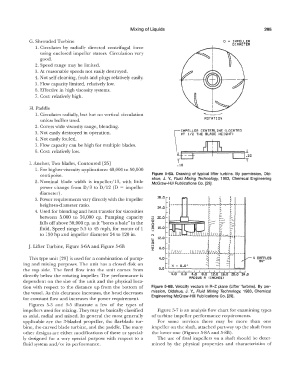
                  centipoise.                                    Figure  5-6A.  Drawing  of typical  lifter turbine.  By  permission,  Old-
                2. Nominal  blade  width  is  impeller/IO,  with  little   shue,  J.  Y.,  Fluid  Mixing  Technology,  1983,  Chemical  Engineering
                                                                 McGraw-Hill Publications Co.  (29].
                  power change  from  D/8 to D/12  (D  =  impeller
                  diameter).
                                                                   28.0
                3.  Power requirements vary directly with the impeller
                  height-to-diameter ratio.                        24.0
                4.  Used for blending and heat transfer for viscosities
                  between  5,000  to  50,000  cp.  Pumping  capacity   f:l  20.0
                  falls off above 50,000 cp, as it "bores a hole" in the
                  fluid.  Speed range  5.5  to  45  mph,  for motor of 1   �  ...  16.0
                  to  150 hp and impeller diameter 24 lo  120 in.   N
                                                                1-  12,0
                                                                J:
             J.  Lifter Turbine,  Figure 5-6A and Figure 5-6B   (.!)
                                                                t;j
                                                                J:   8.0
             This type unit [29]  is used for a combination of pump-   4.0                                 4  BAFFLES
                                                                                                             so-
           ing and  mixing  purposes.  The  unit has  a  closed disk  on
           the  top  side.  The  feed  flow  into  the  unit  comes  from   o.o
                                                                                 4.o
                                                                                         12.0  16.0  20.0  24,0
                                                                                     a.o
           directly  below  the  rotating impeller.  The  performance is   4,0   o.o   RADIUS  R  !INCHESl
           dependent on  the size of the  unit and  the  physical  loca-
           tion with  respect to  the distance  up from  the  bottom  of   Figure 5-68.  Velocity vectors  in  R-Z  plane  (Lifter Turbine).  By  per-
           the vessel. As this clearance increases,  the head decreases   mission,  Oldshue,  J.  Y.,  Fluid  Mixing  Technology,  1983,  Chemical
           for constant flow and increases the power requirement.   Engineering McGraw-Hill Publications Co.  [29].
             Figures  5-3  and  5-5  illustrate  a  few  of  the  types  of
           impellers used for mixing. They may be basically classified   Figure 5-7 is an  analysis flow chart for examining types
           as  axial,  radial  and mixed.  In general  the most generally   of turbine impeller performance requirements.
           applicable  are  the  3-bladed  propeller,  the  flat-blade  tur-   For  some  services  there  may  be  more  than  one
           bine, the curved blade turbine, and the paddle. The many   impeller on the shaft, attached part-way up the shaft from
           other designs are either modifications of these or special-   the lower one  (Figures 5-SA and 5-8B).
           ly  designed  for a  very special  purpose  with  respect  to  a   The  use  of dual  impellers  on  a  shaft should be deter-
           fluid system and/or its performance.                 mined  by  the  physical  properties  and  characteristics  of

