


Page 657 - APPLIED PROCESS DESIGN FOR CHEMICAL AND PETROCHEMICAL PLANTS, Volume 1, 3rd Edition
P. 657
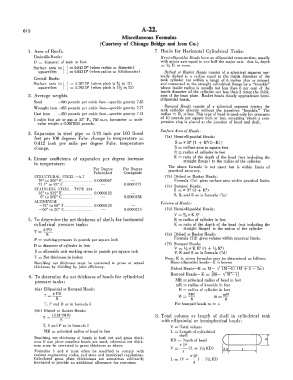
610                                              A-22.
                                                    Miscellaneous Formulas
                                           ( Courtesy  of Chicago  Bridge and  Iron  Co.)
             1.  Area  of Roofs.                                  7.  Heads  for Horizontal  Cylindrical  Tanks:
               Umbrella Roofs:                                      Hemi-ellipsoidal Heads  have  an  ellipsoidal  cross section,  usually
               D  =  diameter of  tank  in  feet.                   with  minor axis  equal  to  one half  the  major axis-that is,  depth
                                                                    = �  D,  or more.
               Surface  area  in }  {  = 0.842 D 2   ( when radius = diameter)
                 square feet   = 0.882 D"  (when radius= 0.8 diameter)   Dished  or  Basket  Heads  consist  of  a  spherical  segment  nor-
                                                                    mally  dished  to  a  radius  equal  to  the  inside  diameter  of  the
               Conical  Roofs:                                      tank  cylinder  (or  within  a  range  of  6  inches  plus  or  minus)
               Surface  area  in}  {  = 0.787 o•  (when  pitch  is% in  12)   and  connected  to  the  straight cylindrical  flange  by  a  "knuckle"
                 square feet   = 0.792 o•  (when  pitch  is lY:i  in  12)   whose  inside  radius  is  usually  not  less  than  6  per  cent  of  the
                                                                    inside  diameter  of  the  cylinder  nor less  than  3  times  the  thick-
             2.  Average  weights.                                  ness  of the  head  plate.  Basket heads  closely  approximate  hemi-
                                                                    ellipsoidal  heads.
               Steel     -490  pounds  per  cubic  foot-specific  gravity  7.85
               Wrought iron -485  pounds  per cubic  foot-specific  gravity  7.77   Bumped  Heads  consist  of  a  spherical  segment  joining  the
                                                                    tank  cylinder  directly  without  the  transition  "knuckle."  The
               Cast  iron   --450  pounds  per  cubic  foot-specific  gravity  7.21   radius  = D, or less.  This type of head is used only for  pressures
               l cubic  foot  air  or gas  at 32°  F.,  760  m.m.  barometer  = mole-   of  10  pounds  per  square  inch  or  less,  excepting  where  a  com-
                 cular weight x  0.0027855  pounds.                 pression  ring  is  placed  at  the  junction  of  head  and  shell.
                                                                    Sur/ace Area of Heads:
             3.  Expansion  in  steel  pipe  = 0.78  inch  per  100  lineal
               feet  per  100  degrees  Fahr.  change  in  temperature  =   (7a)  Hemi-ellipsoidal  Heads:
                                                                                       0
               0.412  inch  per  mile  per  degree  Fahr.  temperature    S =,..  R [l +  K (2-K) J
                                                                                2
               change.                                                    S = surface area  in square feet
                                                                          R = radius of cylinder in  feet
             4.  Linear  coefficients  of  expansion  per  degree  increase   K = ratio  of  the  depth  of  the  head  (not  including  the
               in  temperature:                                               straight  flange)  to  the  radius  of the  cylinder
                                        Per Degree   Per Degree        The  above  formula  is  not  exact  but  is  within  limits  of
                                                                       practical  accuracy.
                                        Fahrenheit   Centigrade
               STRUCTURAL  STEEL-A-7                                  (7b)  Dished  or  Basket  Heads:
                 70° to  200° F         0.0000067                         Formula  (7a)  gives  surface  area  within  practical  limits.
                 21.1 °  lo  93° C     .             0.0000121        (7c)  Bumped  Heads:
               STAINLESS  STEEL·  TYPE  304                               S = ,..  R' (1  + K")
                 32° to  932° F         0.0000102                         S,  R,  and K  as in  formula  (7a)
                  0°  lo  500° C.      .             0.0000184
               ALUMINUM                                             Volume of Heads:
                 -76°  to  68° F        0.0000120
                 -60°  to  20° C.      .             0.0000216        ( 7 d)  Hemi-ellipsoidal  Heads:
                                                                          V  =%,..KR"
             5.  To  determine the net thickness  of shells for horizontal   R = radius of cylinder in  feet
               cylindrical  pressure  tanks:                              K = ratio  of  the  depth  of  the  head  ( not  including  the
                                                                              straight  flange)  to  the  radius  of  the  cylinder
               T= 6PD
                    s                                                 (7e)  Dished  or Basket Heads:
               P  = working pressure  in pounds per square  inch          Formula  (7d)  gives volume within  practical  limits.
               D  = diameter of cylinder in  feet                     (70  Bumped  Heads:
                                                                          V = Y:l  ,..  K R' (1 + Ifs  K 2)
                S = allowable unit working stress in pounds per square inch   V,  Kand  R  as in formula  (7d)
               T = Net thickness  in  inches                          Note:  K  in  above  formulas  may  be  determined  as  follows:
               Resulting  net  thickness  must  be  corrected  to  gross  or  actual   Herni-ellipsoidal heads-K  is known
               thickness  by  dividing  by  joint  efficiency.
                                                                        Dished  Heads-K = M- \I  (M-1)  (M + l  - 2m)
                                                                        Bumped Heads-  K =  [M- V  M"-1]
             6.  To  determine the net thickness  of heads for cylindrical
                pressure  tanks:                                          MR = principal radius of head  in  feet
                                                                          mR = radius of knuckle  in  feet
                (6a)  Ellipsoidal  or Bumped  Heads:                        R = radius  of cylinder in  feet
                   T= 6PD                                                  M= MR          m=mR
                        s                                                        R             R
                   T,  P  and  D  as  in  formula  5                      For bumped  heads m  = o
               (6b)  Dished  or Basket Heads:
                   T  =  10.6P(MR)                                8.  Total  volume  or  length  of  shell  in  cylindrical  tank
                          s                                         with ellipsiodal or hemispherical heads:
                   T,  S  and P  as  in formula 5                       V  = Total  volume
                   MR  =  principal radius of head  in  feet            L  = Length  of cylindrical   c
               Resulting  net  thickness  of  heads  is  both  net  and  gross  thick-   shell   I          I )IT
                                                                                                                O
                                                                                                         _
               ness  if one piece  seamless  heads  are  used,  otherwise  net  thick-   KD = Depth of head   .....___- -
                                                                                              I
               ness  must  be  corrected  to  gross  thickness  as  above.   v =  ,..  D'   KD)icol        �
               Formulas  5  and  6  must  often  be  modified  to  comply  with   -4-  (L + 1\1:i
               various  engineering  codes,  and  state  and  municipal  regulations.   .,,.oz
               Calculated  gross  plate  thicknesses  are  sometimes  arbitrarily   L= (V7-)  -1\l;iKD
               increased  to  provide  an  additional  allowance  for  corrosion.   4

