


Page 246 - English for Writing Research Papers
P. 246
231

            13.15       How should I begin my Abstract?


             When you read an advertisement for a product it never begins  The objective of this
            advertisement is to convince you to buy …  Instead advertisers go straight to the
            point. Abstracts are like advertisements for your paper.


              You want your abstract to stand out so that there will be a better chance someone will
            notice it and read it. If you begin your abstract with commonly used phrases (by both
            native and non-native English speakers) such as  This paper deals with … The aim of
            this paper … This article explores … We report …  you are not differentiating yourself
            from the others. In fact, some journals advise against using such expressions.


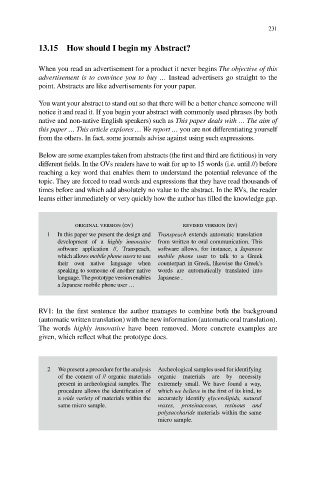
              Below are some examples taken from abstracts (the first and third are fictitious) in very

            different fields. In the OVs readers have to wait for up to 15 words (i.e. until //) before
            reaching a key word that enables them to understand the potential relevance of the
            topic. They are forced to read words and expressions that they have read thousands of
            times before and which add absolutely no value to the abstract. In the RVs, the reader
            learns either immediately or very quickly how the author has filled the knowledge gap.


                         original version (ov)         revised version (rv)
                1   In this paper we present the design and    Transpeach  extends automatic translation
                 development of a  highly innovative   from written to oral communication. This
                 software application //,  Transpeach,  software allows, for instance, a  Japanese
                 which allows  mobile phone users  to use  mobile phone  user to talk to a Greek
                 their own native language when  counterpart in Greek, likewise the Greek's
                 speaking to someone of another native  words are automatically translated into
                 language. The prototype version enables  Japanese .
                 a Japanese mobile phone user …


                RV1:  In  the  first sentence the author manages to combine both the background

            (automatic written translation) with the new information (automatic oral  translation).
            The words  highly innovative  have been removed. More concrete examples are

            given, which reflect what the prototype does.


                2     We present a procedure for the analysis   Archeological samples used for identifying
                 of the content of // organic materials  organic materials are by necessity
                 present in archeological samples. The  extremely small.  We have found a way,
                 procedure allows the identifi cation of  which  we believe  is the fi rst of its kind, to
                 a  wide variety  of materials within the  accurately identify  glycerolipids, natural
                 same micro sample.          waxes, proteinaceous, resinous and
                                             polysaccharide  materials within the same
                                             micro sample.

