


Page 268 - English for Writing Research Papers
P. 268
254

            14.5        How should I begin my Introduction?


             Below is an example of the structure of a typical Introduction. It consists of a

            sequence of ten parts, each with a specific role. Your Introduction will not necessar-
            ily include all ten parts nor sequence them in the same order.

              Your aim is to include only enough background information to allow your reader to
            understand why you are asking the questions you are, in what context they appear,
            and why your hypotheses, predictions or expected results are reasonable. It is like a
            preview to the rest of the paper. Thus, nearly every Introduction, irrespective of the
            discipline, would incorporate those parts marked with an asterisk (*).
              The proportion of space given to each part (particularly with regard to the review of
            the literature) will obviously vary from discipline to discipline, and from paper to
            paper.

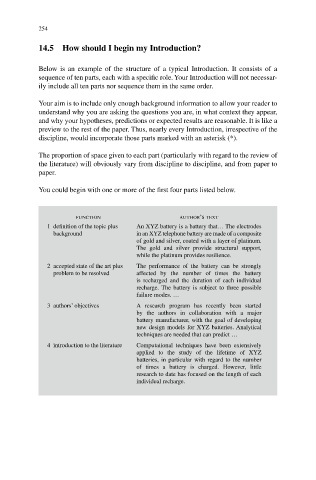
              You could begin with one or more of the first four parts listed below.


                         function                     author’s text

               1   definition of the topic plus    An XYZ battery is a battery that… The electrodes
                background             in an XYZ telephone battery are made of a composite
                                       of gold and silver, coated with a layer of platinum.
                                       The gold and silver provide structural support,
                                       while the platinum provides resilience.
                2   accepted state of the art plus    The performance of the battery can be strongly
                problem to be resolved   affected by the number of times the battery
                                       is recharged and the duration of each individual
                                       recharge. The battery is subject to three possible
                                       failure modes. …
                3  authors’ objectives     A research program has recently been started
                                       by the authors in collaboration with a major
                                       battery manufacturer, with the goal of developing
                                       new design models for XYZ batteries. Analytical
                                       techniques are needed that can predict …
                4  introduction to the literature     Computational techniques have been extensively
                                       applied to the study of the lifetime of XYZ
                                       batteries, in particular with regard to the number
                                       of times a battery is charged. However, little
                                       research to date has focused on the length of each
                                       individual recharge.

