


Page 290 - English for Writing Research Papers
P. 290
Chapter 16


             Methods


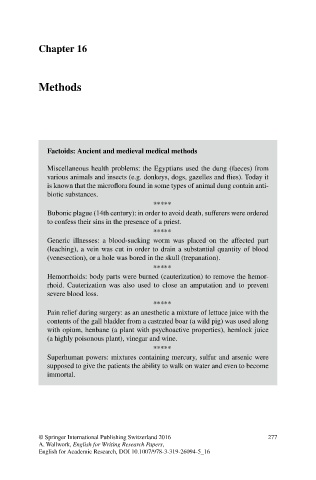
                Factoids: Ancient and medieval medical methods

               Miscellaneous health problems: the Egyptians used the dung (faeces) from
              various animals and insects (e.g. donkeys, dogs, gazelles and fl ies). Today it
              is known that the microflora found in some types of animal dung contain anti-

              biotic substances.
                                             *****
                Bubonic plague (14th century): in order to avoid death, sufferers were ordered
              to confess their sins in the presence of a priest.
                                             *****
                Generic illnesses: a blood-sucking worm was placed on the affected part
              (leaching), a vein was cut in order to drain a substantial quantity of blood
              (venesection), or a hole was bored in the skull (trepanation).
                                             *****
                Hemorrhoids: body parts were burned (cauterization) to remove the hemor-
              rhoid. Cauterization was also used to close an amputation and to prevent
              severe blood loss.
                                             *****
                Pain relief during surgery: as an anesthetic a mixture of lettuce juice with the
              contents of the gall bladder from a castrated boar (a wild pig) was used along
              with opium, henbane (a plant with psychoactive properties), hemlock juice
              (a highly poisonous plant), vinegar and wine.
                                             *****
                Superhuman powers: mixtures containing mercury, sulfur and arsenic were
              supposed to give the patients the ability to walk on water and even to become
              immortal.


            © Springer International Publishing Switzerland 2016            277
            A. Wallwork, English for Writing Research Papers,
            English for Academic Research, DOI 10.1007/978-3-319-26094-5_16

