


Page 288 - English for Writing Research Papers
P. 288
274


            15.8   How can I reduce the amount I write when reporting
                  the literature?
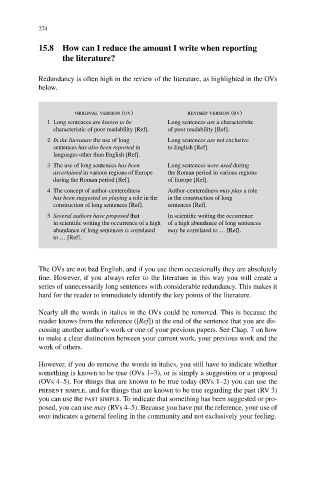
             Redundancy is often high in the review of the literature, as highlighted in the OVs
            below.


                         original version (ov)          revised version (rv)
               1   Long sentences  are known to be      Long sentences  are  a characteristic
                characteristic of poor readability [Ref].   of poor readability [Ref].
               2    In the literature  the use of long     Long sentences  are  not exclusive
                sentences  has also been reported  in   to English [Ref].
                languages other than English [Ref].
                3   The use of long sentences  has been     Long sentences  were used  during
                ascertained  in various regions of Europe   the Roman period in various regions
                during the Roman period [Ref].   of Europe [Ref].
                4   The concept of author-centeredness    Author-centeredness  may play  a role
                  has been suggested as playing  a role in the   in the construction of long
                construction of long sentences [Ref].   sentences [Ref].
               5    Several authors have proposed  that    In scientific writing the occurrence


                in scientific writing the occurrence of a high  of a high abundance of long sentences
                abundance of long sentences  is  correlated     may  be correlated to … [Ref].
                to … [Ref].


                The OVs are not bad English, and if you use them occasionally they are absolutely

            fine. However, if you always refer to the literature in this way you will create a
            series of unnecessarily long sentences with considerable redundancy. This makes it
            hard for the reader to immediately identify the key points of the literature.

             Nearly all the words in italics in the OVs could be removed. This is because the
            reader knows from the reference ([ Ref ]) at the end of the sentence that you are dis-
            cussing another author’s work or one of your previous papers. See Chap.    7    on how

            to make a clear distinction between your current work, your previous work and the
            work of others.

             However, if you do remove the words in italics, you still have to indicate whether
            something is known to be true (OVs 1–3), or is simply a suggestion or a proposal
            (OVs 4–5). For things that are known to be true today (RVs 1–2) you can use the
              present simple , and for things that are known to be true regarding the past (RV 3)
            you can use the  past simple . To indicate that something has been suggested or pro-
            posed, you can use  may  (RVs 4–5). Because you have put the reference, your use of
              may  indicates a general feeling in the community and not exclusively your feeling.

