


Page 304 - English for Writing Research Papers
P. 304
291

                All three examples mean exactly the same thing. The first is the shortest and most

            commonly used. It is also the one that gives rise to the most mistakes. This is
            because  allow, enable  and  permit  require an agent before the infinitive. Hence the

            use of  us  in the first example is obligatory.

               Allow, enable  and  permit  involve long constructions but can often be eliminated,

            generally without any change in meaning. If you find yourself using  allow   and
              enable  very frequently, then consider using the alternatives given below. In some
            cases you may feel that the RV is slightly different in terms of meaning from the OV,
            in such cases it is best to stick with the OV.


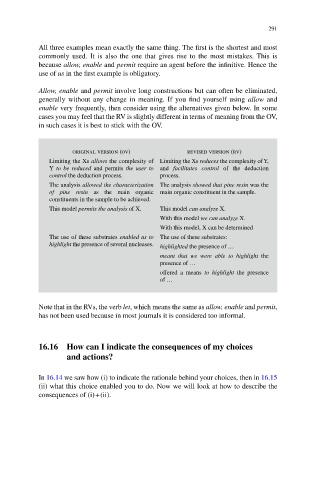
                        original version (ov)          revised version (rv)
                 Limiting the Xs  allows  the complexity of   Limiting the Xs  reduces  the complexity of Y,
               Y  to be reduced  and permits  the user to  and  facilitates control  of the deduction
               control  the deduction process.   process.
                 The analysis  allowed the characterization   The analysis  showed that pine resin  was the
               of pine resin  as the main organic  main organic constituent in the sample.
               constituents in the sample to be achieved.
                 This model  permits the analysis  of X.     This model  can analyze  X.
                                                With this model  we can analyze  X.
                                                With this model, X can be determined
                 The use of these substrates  enabled us to   The use of these substrates:
               highlight  the presence of several nucleases.      highlighted  the presence of …
                                                 meant that we were able to highlight   the
                                              presence of …
                                               offered a means  to highlight   the  presence
                                              of …


                    Note that in the RVs, the verb  let , which means the same as  allow, enable  and  permit ,
            has not been used because in most journals it is considered too informal.


            16.16   How can I indicate the consequences of my choices


                    and actions?
             In  16.14  we saw how (i) to indicate the rationale behind your choices, then in  16.15
            (ii) what this choice enabled you to do. Now we will look at how to describe the
            consequences of (i) + (ii).

