


Page 39 - Basic Japanese
P. 39
Just as we hear Japanese ai and ae alike, we tend to hear

                Japanese  au  and  ao  the  same.  Listen  carefully  to  the
                difference between these pairs:


                      [cue 01-9]


                                 kau                          buys
                                 au                           meets


                              kao                             face
                              ao                              blue


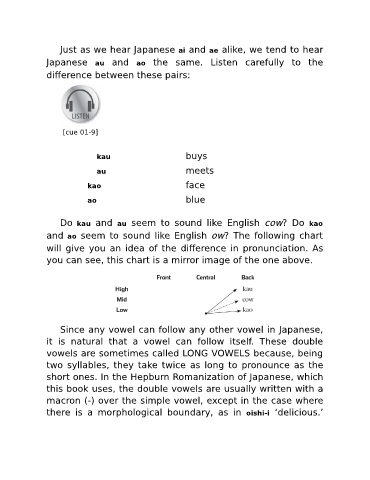
                     Do  kau  and  au  seem  to  sound  like  English  cow?  Do  kao

                and ao seem to sound like English ow? The following chart
                will give you an idea of the difference in pronunciation. As
                you can see, this chart is a mirror image of the one above.


                     Since any vowel can follow any other vowel in Japanese,
                it  is  natural  that  a  vowel  can  follow  itself.  These  double

                vowels are sometimes called LONG VOWELS because, being
                two syllables, they take twice as long to pronounce as the

                short ones. In the Hepburn Romanization of Japanese, which
                this book uses, the double vowels are usually written with a

                macron (-) over the simple vowel, except in the case where
                there  is  a  morphological  boundary,  as  in  oishi-i  ‘delicious.’

