


Page 34 - Basic Japanese
P. 34
often unvoiced when followed by the same syllable: kakanai
                ‘does  not  write,’  koko  ‘here.’  And  ha  and  ho  are  often
                unvoiced  when  followed  by  a  voiceless  consonant  and  the

                same vowel: haka ‘grave,’ hokori ‘dust,’ and hosoi ‘slender.’


                1.5. Vowels


                There  is  a  striking  difference  between  the  way  a  Japanese
                person  pronounces  his  vowels  and  the  way  an  American

                pronounces his. Japanese vowels seem to stand still. English
                vowels  often  slide  off  from  their  starting  points  in  one  of

                three directions: with the tongue moving front and up (as in
                key, bay, shy, and toy); with the tongue moving back and up

                and the lips rounding (as in now, know, and who); with the
                tongue  relaxing  toward  a  central  position  (as  in  yeah,  ah,
                law, uh, and huh; with many speakers also in bad, bed, bid,

                and bud; with some Southern and Western speakers also in
                bat, bet, bit, and butt).

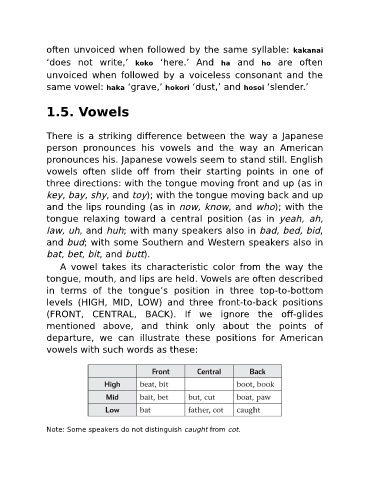
                     A  vowel  takes  its  characteristic  color  from  the  way  the
                tongue, mouth, and lips are held. Vowels are often described

                in  terms  of  the  tongue’s  position  in  three  top-to-bottom
                levels  (HIGH,  MID,  LOW)  and  three  front-to-back  positions

                (FRONT,  CENTRAL,  BACK).  If  we  ignore  the  off-glides
                mentioned  above,  and  think  only  about  the  points  of

                departure,  we  can  illustrate  these  positions  for  American
                vowels with such words as these:


                Note: Some speakers do not distinguish caught from cot.

