


Page 32 - Guildmasters' Guide to Ravnica
P. 32
combat) or flee from them. You  might assign them to   A vedalken paladin in the Boros Legion, or an Ordruun
             perform tasks in your absence, which could include un-  minotaur in the Orzhov Syndicate, would fall into
             dertaking research. looking for witnesses to a crime, or   this category.
             carrying out a small-scale raid, for example, depending
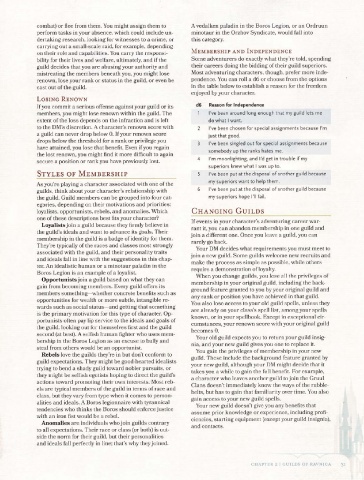
             on their role and capabilities. You carry the responsi-  MEMBERSHIP AND  I NDEPENDENCE
             bility for their lives and welfare, ultimately, and if the   Some adventurers do exactly what they're told, spending
             guild decides that you are abusing your authority and   their careers doing the bidding of their guild superiors.
             mistreating the members beneath you. you might lose   Most adventuring characters, though, prefer more inde-
             renown. lose your rank or status in the guild, or even be   pendence. You can roll a d6 or choose from the options
             cast out of the guild.                            in the table below to establish a reason for the freedom
                                                               enjoyed by your character.
             LOSI NG  R ENOWN
             If you commit a serious offense against your guild or its   d6   Reason for Independence
             members, you might lose renown within the guild. The    I've been around long enough that my guild lets me
             extent of the loss depends on the infraction and is left   do what I want.
             to the DM's discretion. A character's renown score with   2   I've been chosen for special assignments because I'm
             a guild can never drop below 0. If  your renown score   just that good.
             drops below the threshold for a rank or privilege you   3   I've been singled out for special assignments because
             have attained, you lose that benefit. Even if  you regain
             the lost renown, you might find it more difficult to again   somebody up the ranks hates me.
             secure a position or rank you have previously lost.   4   I'm moonlighting, and I'd get in trouble if  my
                                                                     superiors knew what I was up to.
             STYLES  OF MEMBERSHIP                               5   I've been put at the disposal of  another guild because
                                                                     my superiors want to help them.
             As you're playing a character associated with one of the
             guilds, think about your character's relationship with   6   I've been put at the disposal of  another guild because
             the guild. Guild members can be grouped into four cat-  my superiors hope I'll fail.
             egories, depending on their motivations and priorities:
             loyalists, opportunists, rebels, and anomalies. Which   CHANGING GUILDS
             one of these descriptions best fits your character?   If  events in your character's adventuring career war-
               Loyalists join a guild because they firmly believe in   rant it, you can abandon membership in one guild and
             the guild's ideals and want to advance its goals. Their   join a different one. Once you leave a guild, you can
             membership in the guild is a badge of identity for them.
             They're typically of the races and classes most strongly   rarely go back.
                                                                 Your DM decides what requirements you must meet to
             associated with the guild, and their personality traits   join a new guild. Some guilds welcome new recruits and
             and ideals fall  in line with the suggestions in this chap-  make the process as simple as possible, while others
             ter. An idealistic human or a minotaur paladin in the
             Boros Legion is an example of a loyalist.         requi re a demonstration of loyalty.
                                                                 When you change guilds, you lose all  the privileges of
               Opportunists join a guild based on what they can   membership in your original guild, including the back-
             gain from becoming members. Every guild offers its   ground feature granted to you by your original guild and
             members something-whether concrete benefits such as
             opportunities for wealth or more subtle, intangible re-  any rank or position you have achieved in that guild.
                                                               Y ou also lose access to your old guild spells, unless they
             wards such as social status- and getting that something
             is the primary motivation for this type of  character. Op-  are already on your class's spell list, among your spells
                                                               known. or in your spellbook. Except in exceptional cir-
             portunists often pay lip service to the ideals and goals of   cumstances, your renown score with your original guild
             the guild, looking out for themselves first and the guild
             second (at best). A selfish human fighter who uses mem-  becomes 0.
                                                                 Your old guild expects you to return your guild insig-
             bership in the Boros Legion as an excuse to bully and   nia, and your new guild gives you one to replace it.
             steal from others would be an opportunist.          You gain the privileges of membership in your new
               Rebels love the guilds they're in but don't conform to
             guild expectations. They might be good-hearted idealists   guild. These include the background feature granted by
                                                               your new guild, although your DM might decide that it
             trying to bend a shady guild toward nobler pursuits, or   takes you a while to gain the full benefit. For example,
             they might be selfish egotists hoping to direct the guild's   a character who leaves another guild to join the Gruul
             actions toward promoting their own interests. Most reb-  Clans doesn't immediately know the ways of the rubble-
             els are typical members of the guild in terms of race and   belts, but has to gain that familiarity over time. You also
             class, but they vary from type when it comes to person-
             alities and ideals. A Boros legionnaire with tyrannical   gain access to your new guild spells.
                                                                 Your new guild doesn't give you any benefits that
             tendencies who thinks the Boros should enforce justice   assume prior knowledge or experience, including profi-
             with an iron fist would be a rebel.               ciencies. starting equipment (except your guild insignia),
               Anomalies are individuals who join guilds contrary
             to all expectations. Their race or class (or both) is out-  and contacts.
             side the norm for their guild, but their personalities
             and ideals fall  perfectly in line; that's why they joined.


                                                                                   CHAPTER    Ull OS  OJ  RA\ NJCA   11

