


Page 251 - Dungeon Master's Guide
P. 251
CREATURE SIZE ON SQUARES A  D  HEXES              anacker's space or the point of origin of an area of effect.
         A creature's size determines how much space it    Then trace imaginary lines from that corner to every
         occupies on squares or hexes, as shown in the Creature   corner of any one square the target occupies. If one or
         Size and Space table. If the miniature you use for a   two of those lines are blocked by an obstacle (including
         monster takes up an amount of space different from   another creature), the target has half cover. If three or
         what's on the table, that's fine, but treat the monster   four of those lines are blocked but the attack can still
         as its official size for all other rules. For example,   reach the target (such as when the target is behind an
         you might use a miniature that has a Large base to   arrow slit), the target has three-quarters cover.
         represent a Huge giant. That giant takes up less space   On hexes, use the same procedure as a grid, drawing
         on the battlefield than its size suggests, but it is still   lines between the corners of the hexagons. The target
         Huge for the purposes of rules like grappling.    has half cover if up to three lines are blocked by an
                                                           obstacle, and three-quarters cover if four or more lines
         CREATURE  SIZE  AND  SPACE                        are blocked but the attack can still reach the target.
          Size      Space: Squares       Space: Hexes      OPTIONAL RULE :  FLANKING
         Tiny       4 per square         4 per hex         If you regularly use miniatures, flanking gives
          Small     1 square             1 hex             combatants a simple way to gain advantage on attack
          Medium    1 square             1 hex             rolls against a common enemy.
          Large     4 squares  (2  by  2)   3 hexes         A creature can't flank an enemy that it can't see. A
          Huge      9 squares  (3  by 3)   7 hexes         creature also can't flank while it is incapacitated. A
          Gargantuan  16 squares  (4  by 4)  or more  12  hexes or more   Large or larger creature is flanking as long as at least
                                                           one square or hex of its space qualifies for flanking.
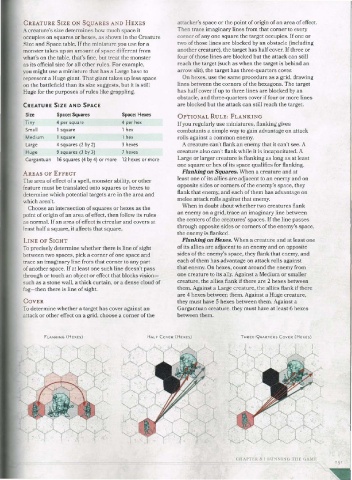
                                                            Flanking on Squares. When a creature and at
         A REAS  OF EFFECT
         The area of effect of a spell, monster ability, or other   least one of its allies are adjacent to an enemy and on
         feature must be translated onto squares or hexes to   opposite sides or corners of the enemy's space, they
                                                           flank that enemy, and each of them has advantage on
         determine which potential targets are in the area and
                                                           melee attack rolls against that enemy.
         which aren't.
                                                            When in doubt about whether two creatures flank
          Choose an intersection of squares or hexes as the
                                                           an enemy on a grid, trace an imaginary line between
         point of origin of an area of effect, then follow its rules
                                                           the centers of the creatures' spaces. If the line passes
         as normal. If an area of effect is circular and covers at
                                                           through opposite sides or corners of the enemy's space,
         least half a square, it affects that square.
                                                           the enemy is flanked.
         L INE OF SIGHT                                     Flanking on Hexes. When a creature and at least one
         To precisely determine whether there is line of sight   of its allies are adjacent to an enemy and on opposite
         between two spaces, pick a corner of one space and   sides of the enemy's space, they flank that enemy, and
         rrace an imaginary line from that corner to any part   each of them has advantage on attack rolls against
         of another space. If at least one such line doesn't pass   that enemy. On hexes, count around the enemy from
         through or touch an object or effect that blocks vision-  one creature to its ally. Against a Medium or smaller
         such as a stone wall, a thick curtain, or a dense cloud of   creature, the allies flank if there are 2 hexes between
         fog-then there is line of sight.                  them. Against a Large creature, the allies flank if there
                                                           are 4 hexes between them. Against a Huge creature,
         C OVER                                            they must have 5 hexes between them. Against a
         To determine whether a target has cover against an   Gargantuan creature, they must have at least 6 hexes
         attack or other effect on a grid, choose a corner of the   between them.


                FLANKING  (f-lEXES)              11ALF CovER  ( 11EXES)        THREE · QUARTERS  Co v ER  (11EXES)


                                                                              CHAPTER 8  I RUNNlNG THE  GAME

