


Page 246 - Dungeon Master's Guide
P. 246
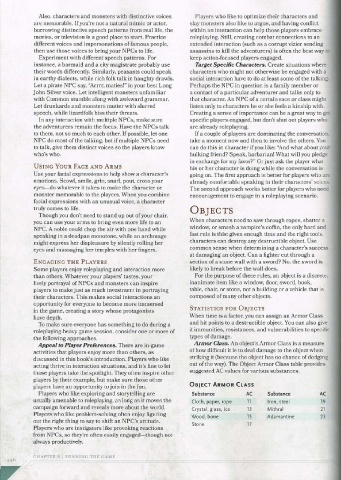
Also, characters and monsters with distinctive voices   Players who like to optimize their characters and
            are memorable. If you're not a natural mimic or actor,   slay monsters also like to argue, and having conflict
            borrowing distinctive speech patterns from real life, the   within an interaction can help those players embrace
            movies, or television is a good place to start. Practice   roleplaying. Still, creating combat connections to an
            different voices and impersonations of famous people,   extended interaction (such as a corrupt vizier sending
            then use those voices to bring your NPCs to life.   assassins to kill the adventurers) is often the best way r
              Experiment with different speech patterns. For   keep action-focused players engaged.
            instance, a barmaid and a city magistrate probably use   Target Specific Characters. Create situations where
            their words differently. Similarly, peasants could speak   characters who might not otherwise be engaged with a
            in earthy dialects, while rich folk talk in haughty drawls.   social interaction have to do at least some of the talk in
            Let a pirate NPC say, "Arrrr, maties!" in your best Long   Perhaps the NPC in question is a family member or
            John Silver voice. Let intelligent monsters unfamiliar   a contact of a particular adventurer and talks only to
            with Common stumble along with awkward grammar.   that character. An NPC of a certain race or class mighr
            Let drunkards and monsters mutter with slurred    listen only to characters he or she feels a kinship with.
            speech, while lizardfolk hiss their threats.      Creating a sense of importance can be a great way to ge-
             In any interaction with multiple NPCs, make sure   specific players engaged, but don't shut out players who
            the adventurers remain the focus. Have the NPCs talk   are already roleplaying.
            to them, not so much to each other. If possible, let one   If a couple of players are dominating the conversation
            NPC do most of the talking, but if multiple NPCs need   take a moment now and then to involve the others. You
            to talk, give them distinct voices so the players know   can do this in character if you like: "And what about you;-
            who's who.                                        hulking friend? Speak, barbarian! What will you pledge
                                                              in exchange for my favor?" Or just ask the player what
            UsiNG YouR FAcE AND ARMS                          his or her character is doing while the conversation is
            Use your facial expressions to help show a character's   going on. The first approach is better for players who are
            emotions. Scowl, smile, grin, snarl, pout, cross your   already comfortable speaking in their characters' voices
            eyes-do whatever it takes to make the character or   The second approach works better for players who neeri
            monster memorable to the players. When you combine   encouragement to engage in a roleplaying scenario.
            facial expressions with an unusual voice, a character
            truly comes to life.                              OBJECTS
             Though you don't need to stand up out of your chair,
            you can use your arms to bring even more life to an   When characters need to saw through ropes, shatter a
            NPC. A noble could chop the air with one hand while   window, or smash a vampire's coffin, the only hard and
            speaking in a deadpan monotone, while an archmage   fast rule is this: given enough time and the right tools,
            might express her displeasure by silently rolling her   characters can destroy any destructible object. Use
            eyes and massaging her temples with her fingers.   common sense when determining a character's succe
                                                              at damaging an object. Can a fighter cut through a
            ENGAGING THE PLAYERS                              section of a stone wall with a sword? No, the sword is
            Some players enjoy roleplaying and interaction more   likely to break before the wall does.
            than others. Whatever your players' tastes, your   For the purpose of these rules, an object is a discrete.
            lively portrayal of NPCs and monsters can inspire   inanimate item like a window, door, sword, book,
            players to make just as much investment in portraying   table, chair, or stone, not a building or a vehicle that is
            their characters. This makes social interactions an   composed of many other objects.
            opportunity for everyone to become more immersed
            in the game, creating a story whose protagonists   STATISTICS  FOR OBJECTS
            have depth.                                       When time is a factor, you can assign an Armor Class
             To make sure everyone has something to do during a   and hit points to a destructible object. You can also give
            roleplaying-heavy game session, consider one or more of   it immunities, resistances, and vulnerabilities to specific
            the following approaches.                         types of damage.
             Appeal to Player Preferences. There are in-game   Armor Class. An object's Armor Class is a measure
            activities that players enjoy more than others, as   of how difficult it is to deal damage to the object when
                                                              striking it (because the object has no chance of dodging
            discussed in this book's introduction. Players who like
                                                              out of the way). The Object Armor Class table provides
            acting thrive in interaction situations, and it's fine to ·let
                                                              suggested AC values for various substances.
            those players take the spotlight. They often inspire other
            players by their example, but make sure those other
            players have an opportunity to join in the fun.   OBJECT  ARMOR  CLASS
             Players who like exploring and storytelling are   Substance        AC     Substance       AC
            usually amenable to roleplaying, as long as it moves the   Cloth,  paper,  rope   11   I ron, steel   19
            campaign forward and reveals more about the world.   Crystal, glass,  ice   13   Mithral    21
            Players who like problem-solving often enjoy figuring
                                                              Wood, bone        15     Adamantine       23
            out the right thing to say to shift an NPC's attitude.
                                                              Stone             17
            Players who are instigators like provoking reactions
            from NPCs, so they're often easily engaged-though not
            always productively.

            CHAPTER 8  I RUNNING THE GAME

