


Page 275 - Dungeon Master's Guide
P. 275
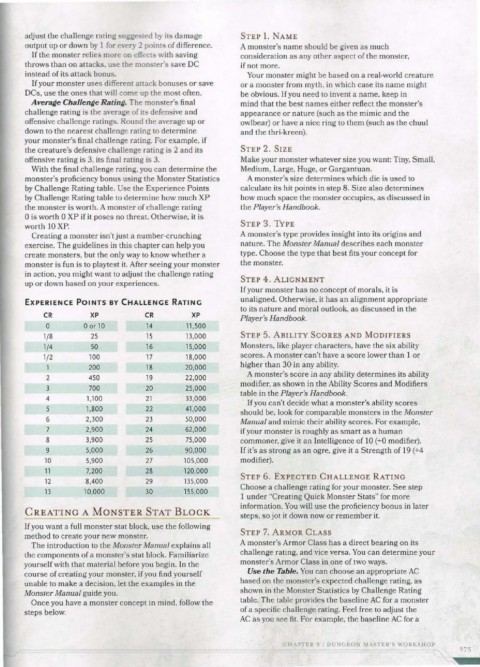
adjust the challenge rating  uggesred by its damage   STEP 1.  N A ME
       output up or down by 1 for e\·ery 2 points of difference.   A monster's name should be given as much
         If the monster relies more on effects with saving   consideration as any other aspect of the monster,
       throws than on attacks, use the monster's save DC   if not more.
       instead of its attack bonus.                        Your monster might be based on a real-world creature
         If your monster uses different attack bonuses or save   or a monster from myth, in which case its name might
       DCs, use the ones that will come up the most often.   be obvious. If you need to invent a name, keep in
         Average Challenge Rating. The monster's final   mind that the best names either reflect the monster's
       challenge rating is the average of its defensive and   appearance or nature (such as the mimic and the
       offensive challenge ratings. Round the average up or   owlbear) or have a nice ring to them (such as the chuul
       down to the nearest challenge rating to determine   and the thri-kreen).
       your monster's final challenge rating. For example, if
       the creature's defensive challenge rating is 2 and its   STEP 2.  SIZE
       offensive rating is 3, its final rating is 3.     Mak6 your monster whatever size you want: Tiny, Small,
         With the final challenge rating, you can determine the   Medium, Large, Huge, or Gargantuan.
       monster's proficiency bonus using the Monster Statistics   A monster's size determines which die is used to
       by Challenge Rating table. Use the Experience Points   calculate its hit points in step 8. Size also determines
       by Challenge Rating table to determine how much XP   how much space the monster occupies, as discussed in
       the monster is worth. A monster of challenge rating   the Player's Handbook.
       0 is worth 0 XP if it poses no threat. Otherwise, it is
       worth 10 XP.                                      STEP 3. T YPE
         Creating a monster isn't just a number-crunching   A monster's type provides insight into its origins and
       exercise. The guidelines in this chapter can help you   nature. The Monster Manual describes each monster
       create monsters, but the only way to know whether a   type. Choose the type that best fits your concept for
       monster is fun is to playtest it. After seeing your monster   the monster.
       in action, you might want to adjust the challenge rating
                                                         STEP 4. ALIGNMENT
       up or down based on your experiences.
                                                         If your monster has no concept of morals, it is
                                                         unaligned. Otherwise, it has an alignment appropriate
       EXPERIENCE  POINTS  BY  CHALLENGE  RAT I NG
                                                         to its nature and moral outlook, as discussed in the
            CR         XP          CR         XP         Player's Handbook.
            0        0 or 10        14       11 ,500
            1/8        25           15       13,000      STEP 5. ABILITY SCORES AND  MODIFIERS
            1/4        50           16       15,000      Monsters, like player characters, have the six ability
            1/2       100           17       18,000      scores. A monster can't have a score lower than 1 or
                                                         higher than 30 in any ability.
            1         200           18       20,000
                                                           A monster's score in any ability determines its ability
            2         450           19       22,000
                                                         modifier, as shown in the Ability Scores and Modifiers
            3         700          20        25,000
                                                         table in the Player's Handbook.
            4         1,100        21        33,000
                                                           If you can't decide what a monster's ability scores
            5         1,800        22        41,000
                                                         should be, look for comparable monsters in the Monster
            6         2,300        23        50,000      Manual and mimic their ability scores. For example,
            7         2,900        24        62,000      if your monster is roughly as smart as a human
            8         3,900        25        75,000      commoner, give it an Intelligence of 10 (+0 modifier).
            9         5,000        26        90,000      If it's as strong as an ogre, give it a Strength of 19 (+4
            10        5,900        27       105,000      modifier).
            11        7,200        28       120,000
                                                         STEP 6.  EXPECTED  CHALLENGE R ATING
            12        8,400        29       135,000
                                                         Choose a challenge rating for your monster. See step
            13       10,000        30       155,000
                                                         1 under "Creating Quick Monster Stats" for more
                                                         information. You will use the proficiency bonus in later
       CREATING A  MONSTER STAT BLOCK                    steps, so jot it down now or remember it.
       If you want a full monster stat block, use the following
                                                         STEP 7. ARMOR CLASS
       method to create your new monster.
         The introduction to the Monster Manual explains all   A monster's Armor Class has a direct bearing on its
       the components of a monster's stat block. Familiarize   challenge rating, and vice versa. You can determine your
       yourself with that material before you begin. In the   monster's Armor Class in one of two ways.
       course of creating your monster, if you find yourself   Use the Table. You can choose an appropriate AC
       unable to make a decision, let the examples in the   based on the monster's expected challenge rating, as
       Monster Manual guide you.                         shown in the Monster Statistics by Challenge Rating
         Once you have a monster concept in mind, follow the   table. The table provides the baseline AC for a monster
                                                         of a specific challenge rating. Feel free to adjust the
       steps below.
                                                         AC as you see fit.  For example, the baseline AC for a

                                                                   CHAPTER 9  I DUNGEON  MASTER'S  WORKSHOP
                                                                                                            ~75

