


Page 277 - Dungeon Master's Guide
P. 277
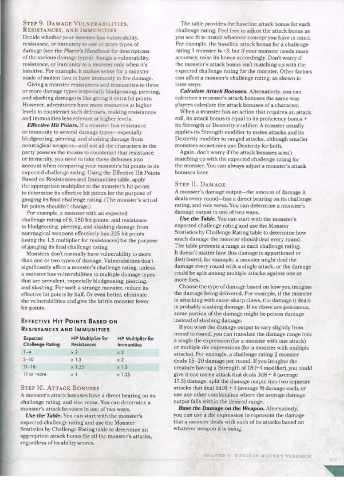
STEP 9.  DAMAGE VuL "ER..'\BILITIES ,              The table provides the baseline attack bonus for each
         RESISTANCES,  AND hnn ; . "ITIE                   challenge rating. Feel free to adjust the attack bonus as
         Decide whether your mon  ter ha  \·ulnerability,   you see fit to match whatever concept you have in mind.
         resistance, or immunity to one or more types of   For example, the baseline attack bonus for a challenge
         damage (see the Players Handbook for descriptions   rating 1 monster is +3, but if your monster needs more
         of the various damage types). .   ign a vulnerability,   accuracy, raise its bonus accordingly. Don't worry if
         resistance, or immunity to a mon  ter only when it's   the monster's attack bonus isn't matching up with the
         intuitive. For example, it make  en  e for a monster   expected challenge rating for the monster. Other factors
         made of molten lava to have immunity to fire damage.   can affect a monster's challenge rating, as shown in
          Giving a monster resistances and immunities to three   later steps.
         or more damage types (especially bludgeoning, piercing,   Calculate Attack Bonuses. Alternatively, you can
         and slashing damage) is like gi\·ing it extra hit points.   calculate a monster's attack bonuses the same way
         However, adventurers have more resources at higher   players calculate the attack bonuses of a character.
         levels to counteract such defense  . making resistances   Wpen a monster has an action that requires an attack
         and immunities less relevant at higher levels.    roll, its attack bonus is equal to its proficiency bonus+
          Effective Hit Points. If a monster has resistance   its Strength or Dexterity modifier. A monster usually
        or immunity to several damage types- especially   applies its Strength modifier to melee attacks and its
        bludgeoning, piercing, and slashing damage from   Dexterity modifier to ranged attacks, although smaller
        nonmagical weapons-and not all the characters in the   monsters sometimes use Dexterity for both.
        party possess the means to counteract that resistance   Again, don't worry if the attack bonuses aren't
        or immunity, you need to take these defenses into   matching up with the expected challenge rating for
        account when comparing your monster's hit points to its   the monster. You can always adjust a monster's attack
        expected challenge rating. Using the Effective Hit Points   bonuses later.
        Based on Resistances and Immunities table, apply
        the appropriate multiplier to the monster's hit points   STEP 11.  DAMAGE
        to determine its effective hit points for the purpose of   A monster's damage output- the amount of damage it
        gauging its final challenge rating. (The monster's actual   deals every round-has a direct bearing on its challenge
        hit points shouldn't change.)                     rating, and vice versa. You can determine a monster's
          For example, a monster with an expected         damage output in one of two ways.
        challenge rating of 6,  150 hit points, and resistance   Use the Table. You can start with the monster's
        to bludgeoning, piercing, and slashing damage from   expected challenge rating and use the Monster
        nonmagical weapons effectively has 225 hit points   Statistics by Challenge Rating table to determine how
        (using the 1.5 multiplier for resistances) for the purpose   much damage the monster should deal every round.
        of gauging its final challenge rating.            The table presents a range at each challenge rating.
          Monsters don't normally have vulnerability to more   It doesn't matter how this damage is apportioned or
        than one or two types of damage. Vulnerabilities don't   distributed; for example, a monster might deal the
        significantly affect a monster's challenge rating, unless   damage every round with a single attack, or the damage
        a monster has vulnerabilities to multiple damage types   could be split among multiple attacks against one or
        that are prevalent, especially bludgeoning, piercing,   more foes.
        and slashing. For such a strange monster, reduce its   Choose the type of damage based on how you imagine
        effective hit points by half. Or even better, eliminate   the damage being delivered. For example, if the monster
        the vulnerabilities and give the brittle monster fewer   is attacking with razor-sharp claws, the damage it deals
        hit points.                                       is probably slashing damage. If its claws are poisonous,
                                                          some portion of the damage might be poison damage
        EFFECTIVE  HIT POINTS  BASED  ON                  instead of slashing damage.
                                                            If you want the damage output to vary slightly from
        RESISTANCES  AND  IMMUNITIES
                                                          round to round, you can translate the damage range into
         Expected        HP Multiplier for   HP Multiplier for   a single die expression (for a monster with one attack)
         Challenge Rating   Resistances   Immunities
                                                          or multiple die expressions (for a monster with multiple
         1-4            x2             x 2                attacks). For example, a challenge rating 2 monster
         5-10           X  1.5         x2                 deals 15- 20 damage per round. If you imagine the
         11-16          X  1.25        X  1.5             creature having a Strength of 18 (+4 modifier), you could
         17 or more     X  1           X  1.25            give it one melee attack that deals 3d8 + 4 (average
                                                          17.5) damage, split the damage output into two separate
        STEP 10. ATTACK BONUSES                           attacks that deal1d10 + 4 (average 9) damage each; or
        A monster's attack bonuses have a direct bearing on its   use any other combination where the average damage
        challenge rating, and vice versa. You can determine a   output falls within the desired range.
        monster's attack bonuses in one of two ways.       Base the Damage on the Weapon. Alternatively,
          Use the Table. You can start with the monster's   you can use a die expression to represent the damage
        expected challenge rating and use the Monster     that a monster deals with each of its attacks based on
        Statistics by Challenge Rating table to determine an   whatever weapon it is using.
        appropriate attack bonus for all the monster's attacks,
        regardless of its ability scores.

                                                                    CHAPTER 9  I DUNGEON  MASTER'S WORKSHOP

