


Page 143 - Module DMV20173
P. 143
7.0 NON CONVENTIONAL PROCESSES


                     7.6  ULTRASONIC MACHINING


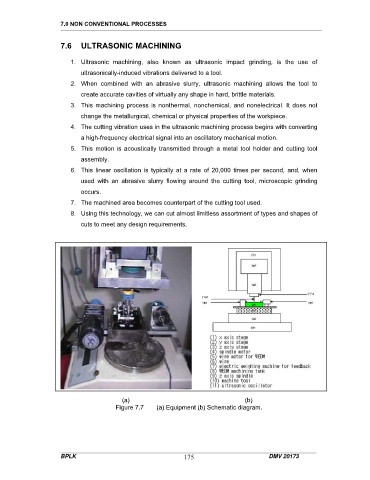
                        1.  Ultrasonic  machining,  also  known  as  ultrasonic  impact  grinding,  is  the  use  of
                            ultrasonically-induced vibrations delivered to a tool.
                        2.  When  combined  with  an  abrasive  slurry,  ultrasonic  machining  allows  the  tool  to

                            create accurate cavities of virtually any shape in hard, brittle materials.
                        3.  This machining process  is nonthermal, nonchemical,  and nonelectrical.  It does not
                            change the metallurgical, chemical or physical properties of the workpiece.

                        4.  The cutting vibration uses in the ultrasonic machining process begins with converting
                            a high-frequency electrical signal into an oscillatory mechanical motion.
                        5.  This motion is acoustically transmitted through a metal tool holder and cutting tool
                            assembly.
                        6.  This  linear  oscillation  is  typically  at  a  rate  of  20,000  times  per  second,  and,  when

                            used  with  an  abrasive  slurry  flowing  around  the  cutting  tool,  microscopic  grinding
                            occurs.
                        7.  The machined area becomes counterpart of the cutting tool used.
                        8.  Using this technology, we can cut almost limitless assortment of types and shapes of

                            cuts to meet any design requirements.


                                         (  a  )                                  (  b  )
                                       Figure 7.7    (a) Equipment (b) Schematic diagram.


                     BPLK                                       175                        DMV 20173

