


Page 4 - Module DMV20173
P. 4
1.0 INTRODUCTION TO MANUFACTURING PROCESSES
1.3 MATERIALS IN MANUFACTURING
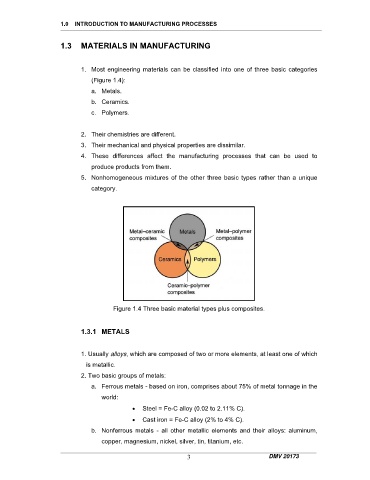
1. Most engineering materials can be classified into one of three basic categories
(Figure 1.4):
a. Metals.
b. Ceramics.
c. Polymers.
2. Their chemistries are different.
3. Their mechanical and physical properties are dissimilar.
4. These differences affect the manufacturing processes that can be used to
produce products from them.
5. Nonhomogeneous mixtures of the other three basic types rather than a unique
category.
Figure 1.4 Three basic material types plus composites.
1.3.1 METALS
1. Usually alloys, which are composed of two or more elements, at least one of which
is metallic.
2. Two basic groups of metals:
a. Ferrous metals - based on iron, comprises about 75% of metal tonnage in the
world:
Steel = Fe-C alloy (0.02 to 2.11% C).
Cast iron = Fe-C alloy (2% to 4% C).
b. Nonferrous metals - all other metallic elements and their alloys: aluminum,
copper, magnesium, nickel, silver, tin, titanium, etc.
3 DMV 20173

