


Page 40 - Module DMV20173
P. 40
3.0 SHEET METAL PROCESSES


                        3.2.4 CHARACTERISTICS AND TYPE OF SHEARING DIES


                        1.  Clearance


                            1.  Because the formability of the sheared part can be influenced by the quality of its
                               sheared edges, clearance control is important.
                            2.  The appropriate clearance depends on:
                               a.  the type of material and its temper;

                               b.  the thickness and size of the blank;
                               c.  its proximity to the edges of other sheared edges or the edges of the original
                                   blank.


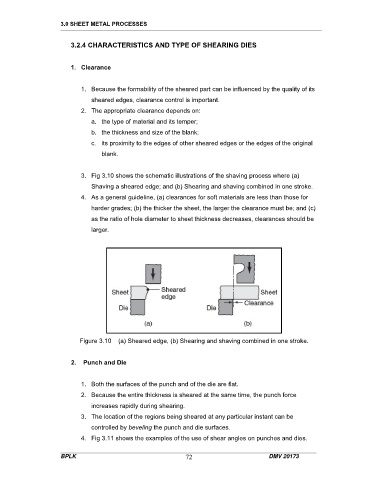
                            3.  Fig 3.10 shows the schematic illustrations of the shaving process where (a)
                               Shaving a sheared edge; and (b) Shearing and shaving combined in one stroke.
                            4.  As a general guideline, (a) clearances for soft materials are less than those for
                               harder grades; (b) the thicker the sheet, the larger the clearance must be; and (c)
                               as the ratio of hole diameter to sheet thickness decreases, clearances should be

                               larger.


                           Figure 3.10    (a) Sheared edge, (b) Shearing and shaving combined in one stroke.

                           2.    Punch and Die

                            1.  Both the surfaces of the punch and of the die are flat.

                            2.  Because the entire thickness is sheared at the same time, the punch force
                               increases rapidly during shearing.
                            3.  The location of the regions being sheared at any particular instant can be
                               controlled by beveling the punch and die surfaces.

                            4.  Fig 3.11 shows the examples of the use of shear angles on punches and dies.

                     BPLK                                       72                         DMV 20173

