


Page 75 - Module DMV20173
P. 75
4.0   BULK DEFORMATION PROCESSES


                       7.  This  increases  its  resistance  to  deformation  compared  to  the  bulk.  Thus  the  flash
                          plays a significant role in helping filling the die cavities.


                   3) Closed Die Forging

                       1.  In closed-die-forging, no flash is formed and the workpiece is completely surrounded
                          by the dies.

                       2.  Therefore, proper control of the volume of material is essential to obtain a forging of
                          desired dimensions.

                       3.  Undersized blanks in close-die forging prevent the complete filling of the die, while
                          oversized blanks may cause premature die failure or jamming of the dies.


                   4.3.3  ADVANTAGES OF FORGING


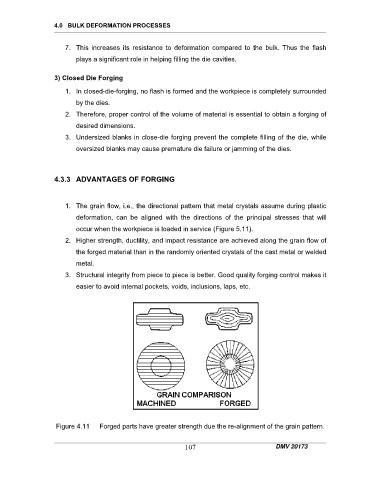
                       1.  The grain flow, i.e., the directional pattern that metal crystals assume during plastic
                          deformation,  can  be  aligned  with  the  directions  of  the  principal  stresses  that  will
                          occur when the workpiece is loaded in service (Figure 5.11).

                       2.  Higher strength, ductility, and impact resistance are achieved along the grain flow of
                          the forged material than in the randomly oriented crystals of the cast metal or welded

                          metal.
                       3.  Structural integrity from piece to piece is better. Good quality forging control makes it
                          easier to avoid internal pockets, voids, inclusions, laps, etc.


                    Figure 4.11   Forged parts have greater strength due the re-alignment of the grain pattern.


                   BPLK                                         107                          DMV 20173

