


Page 92 - Module DMV20173
P. 92
5. 0    JOINING PROCESSES


                     5.2  FUSION WELDING

                        1.  Fusion welding is defined as melting together and coalescing materials by means of

                            heat.
                        2.  Filler metals (which are metals added to the weld area during welding) may be used.
                        3.  Fusion welds made without the use of filler metals are known as autogenous welds.
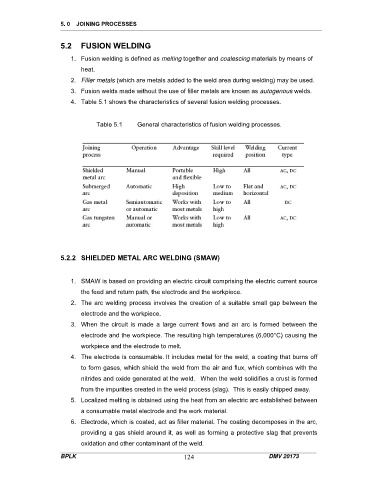
                        4.  Table 5.1 shows the characteristics of several fusion welding processes.


                                 Table 5.1    General characteristics of fusion welding processes.


                     5.2.2  SHIELDED METAL ARC WELDING (SMAW)


                        1.  SMAW is based on providing an electric circuit comprising the electric current source

                            the feed and return path, the electrode and the workpiece.
                        2.  The arc welding process involves the creation of a suitable small gap between the
                            electrode and the workpiece.
                        3.  When  the  circuit  is  made  a  large  current  flows  and  an  arc  is  formed  between  the
                            electrode and the workpiece. The resulting high temperatures (6,000°C) causing the

                            workpiece and the electrode to melt.
                        4.  The electrode is consumable. It includes metal for the weld, a coating that burns off
                            to form gases, which shield the weld from the air and flux, which combines with the
                            nitrides and oxide generated at the weld.   When the weld solidifies a crust is formed

                            from the impurities created in the weld process (slag).  This is easily chipped away.
                        5.  Localized melting is obtained using the heat from an electric arc established between
                            a consumable metal electrode and the work material.
                        6.  Electrode, which is coated, act as filler material. The coating decomposes in the arc,
                            providing a gas shield around it, as well as forming a protective slag that prevents

                            oxidation and other contaminant of the weld.

                     BPLK                                       124                        DMV 20173

