


Page 87 - Module DMV20173
P. 87
4.0   BULK DEFORMATION PROCESSES


                   4.4.7  CRITERIA OF DIE DESIGN


                       1.  The die is usually a piece of steel with the shape of the desired part machined into it.
                       2.  Very tight tolerance.

                       3.  Correct die geometry from the beginning.
                       4.  Carefully finish the land surface.

                       5.  Proper design (giving maximum die life).
                       6.  Rational production resulting in low die manufacturing cost.


                   4.4.8  DIFFERENCE BETWEEN GOOD AND POOR DIE


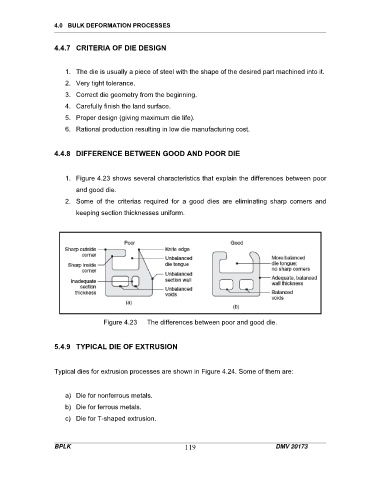
                       1.  Figure 4.23 shows several characteristics that explain the differences between poor
                          and good die.

                       2.  Some  of  the  criterias  required  for  a  good  dies  are  eliminating  sharp  corners  and
                          keeping section thicknesses uniform.


                                   Figure 4.23    The differences between poor and good die.


                   5.4.9  TYPICAL DIE OF EXTRUSION


                   Typical dies for extrusion processes are shown in Figure 4.24. Some of them are:


                       a)  Die for nonferrous metals.
                       b)  Die for ferrous metals.

                       c)  Die for T-shaped extrusion.


                   BPLK                                         119                          DMV 20173

