


Page 2 - 1202 Question Bank Additional Mathematics Form 4
P. 2
MUST


                   KNOW          Important Facts


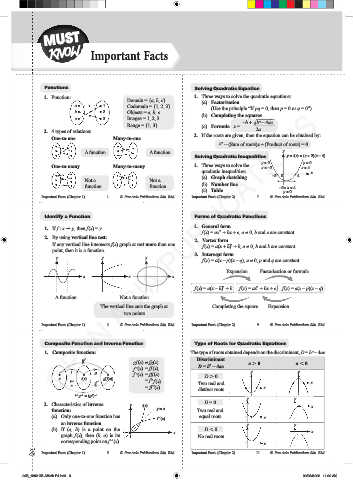
                 Functions                                             Solving Quadratic Equation
                 1.  Function:                                         1.  Three ways to solve the quadratic equations:
                                               Domain = {a, b, c}        (a)  Factorisation
                            a ●      ● 1       Codomain = {1, 2, 3}          (Use the principle “If pq = 0, then p = 0 or q = 0”)
                            b ●      ● 2       Objects = a, b, c         (b)  Completing the squares
                      ©PAN ASIA PUBLICATIONS
                            c ●      ● 3       Images = 1, 2, 3                               2
                                                                                             b  – 4ac
                                               Range = {1, 3}            (c)  Formula  x =   –b + ABBBBBB
                 2.  4 types of relations:                                                   2a
                   One-to-one            Many-to-one                   2.  If the roots are given, then the equation can be obtained by:
                                                                                x  – (Sum of roots)x + (Product of roots) = 0
                                                                                2
                               A function              A function                                     y
                                                                       Solving Quadratic Inequalities   y = f(x) = (x + 2)(x – 4)
                   One-to-many           Many-to-many                  1.  Three ways to solve the    y > 0   y > 0
                                                                         quadratic inequalities:  x < –2     x > 4
                                                                         (a)  Graph sketching     –2  0    4    x
                               Not a                   Not a
                               function                function          (b)  Number line
                                                                         (c)  Table                  –2< x < 4
                                                                                                      y < 0
                Important Facts (Chapter 1)   1   @ Pan Asia Publications Sdn. Bhd.  Important Facts (Chapter 2)   7   @ Pan Asia Publications Sdn. Bhd.


                 Identify a Function                                   Forms of Quadratic Functions
                                                                       1.  General form
                 1.  If f : x → y, then f (x) = y.
                                                                         f (x) = ax  + bx + c, a ≠ 0, b and c are constant
                                                                                2
                 2.  By using vertical line test:                      2.  Vertex form
                   If any vertical line intersects f(x) graph at not more than one   f (x) = a(x + h)  + k, a ≠ 0, h and k are constant
                                                                                    2
                   point, then it is a function.
                                                                       3.  Intercept form
                     y               y               y                   f (x) = a(x – p)(x – q), a ≠ 0, p and q are constant
                                                                                  Expansion   Factorisation or formula
                               x               x               x
                                                                       f (x) = a(x – h)  + k  f (x) = ax  + bx + c  f (x) = a(x – p)(x – q)
                                                                                             2
                                                                                 2
                    A function              Not a function
                                     The vertical line cuts the graph at     Completing the square  Expansion
                                             two points


                Important Facts (Chapter 1)   3   @ Pan Asia Publications Sdn. Bhd.  Important Facts (Chapter 2)   9   @ Pan Asia Publications Sdn. Bhd.

                 Composite Function and Inverse Function               Type of Roots for Quadratic Equations
                 1.  Composite function:                             The type of roots obtained depends on the discriminant, D = b  – 4ac
                                                                                                                 2
                              gf                                       Discriminant
                                                 gf (x) ≠ fg(x)                           a . 0            a , 0
                                                                            2
                                                 f   (x)  = ff (x),     D = b  – 4ac
                                                  2
                                                  3
                      ●   f    ●   g   ●         f   (x)  = fff (x)       D . 0            y                y
                      x       f(x)    g[f(x)]        = f   f (x)
                                                       2
                          f  –1    g –1                                 Two real and                            x
                                                     = ff   (x)
                                                        2
                                                                        distinct roots         x
                           f g  = (gf ) –1                                               y                y
                              –1
                            –1
                 2.  Characteristics of inverse   y  f(x)                 D = 0                                 x
                   function:                             y = x          Two real and
                   (a)  Only one-to-one function has     f (x)           equal roots           x
                                                         –1
                       an inverse function.                                              y                y
                   (b)  If (a,  b) is a point on the                      D , 0                                 x
                       graph  f (x), then (b,  a) is its       x        No real roots
                       corresponding point on f  (x).                                          x
                                        –1
                Important Facts (Chapter 1)   5   @ Pan Asia Publications Sdn. Bhd.  Important Facts (Chapter 2)   11   @ Pan Asia Publications Sdn. Bhd.
         00B_1202 QB AMath F4.indd   3                                                                       09/05/2022   11:30 AM

