


Page 3 - Spotlight A+ Form 4 & 5 Chemistry KSSM
P. 3
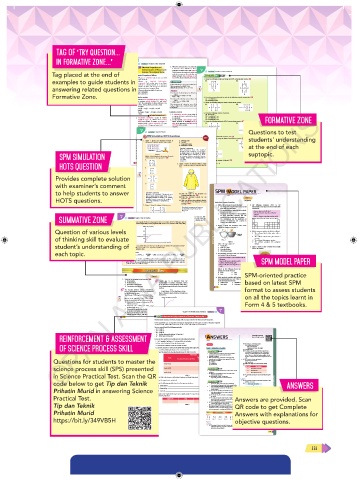
Tag OF ‘TRY QUESTION...
IN FORMATIVE ZONE...’ Form 5 Chemistry Chapter 2 Carbon Compound
2.3 Chemical Properties and 3. When the molecular size of an alkane increases,
Interconversion of Compounds molecules of alkanes burn with sootier flames. 5 Chemistry Chapter 2 Carbon Compound
it becomes more difficult to burn. Large Form
between Homologous Series This is because the number of carbon atoms per
Tag placed at the end of Chemical Properties of Alkane molecule increases as the molecular size of an 2.4
alkane increases. The percentage of carbon by
1. Alkanes are unreactive and do not react with mass in the alkane molecule also increases.
CHAP. most chemicals. 1. Name the following compound using the IUPAC nomenclature system. C2 CHAP.
examples to guide students in 2. Alkanes are saturated hydrocarbon Example 5 (a) H H H (b) H | 2
2
| | |
compounds. Each carbon atom in an alkane
molecule is already bonded to a maximum Explain why butane, C 4 H 10 burns with more sooty CHAP. H–C–C–C–H H–C–H | CHAP.
H H
|
|
number of atoms. The strong C-C and C-H
|
flame compared to ethane, C 2 H 6 .
H H
answering related questions in bonds need a lot of energy to break. [Relative atomic mass: H = 1; C = 12] 2 H–C–H | H H–C–C–C–H 2
|
|
3. Alkanes undergo two types of reactions:
Solution
H H
(a) Combustion
|
(b) Substitution Percentange of carbon by mass in butane, C 4 H 10 H–C–H
H
Formative Zone. Combustion reaction = 4(12) + 10(1) × 100% = 82.76% 2. Draw the structural formula for each of the following organic compounds. C2
4(12)
1. Alkanes burn completely in excess oxygen, O 2 Percentage of carbon by mass in ethane, C 2 H 6 (a) 2-methylbutane
2(12)
(b) 2-methylpropene
to produce carbon dioxide, CO 2 and water, = 2(12) + 6(1) × 100% = 80%
H 2 O. The combustion of alkanes produces a lot 3. Name the following using the IUPAC nomenclature system.
of heat. Hence, alkanes are used as fuels. The percentage of carbon by mass of butane, (a) H H H (b) H H H H
Example: C 4 H 10 is higher. As a result, it burns with more | | | | | | |
CH 4 (g) + 2O 2 (g) → CO 2 (g) + 2H 2 O(l) sooty flame. H–C–C=C–C–H H–C=C–C–C–C–H
| |
| | |
|
Methane H H H H H H
2C 2 H 6 (g) + 7O 2 (g) → 4CO 2 (g) + 6H 2 O(l) Substitution reaction 4. Draw the following isomers of pentene.
©PAN ASIA PUBLICATIONS
Ethane 1. A substitution reaction occurs when an atom (a) Pent-2-ene
Try Question 1 in Formative Zone 2.3
in a molecule.
2. Incomplete combustion occurs in limited or a group of atoms is substitute by other atoms (b) 2-methylbut-1-ene
(c) 3-methylbut-1-ene
supply of oxygen, O 2 . Alkanes burn in sooty 2. In this reaction, each hydrogen atom in an (d) 2-methylbut-2-ene FORMATIVE ZONE
flame and produce a mixture of carbon, C alkane molecule is substituted by a halogen 5. Name the following using the IUPAC nomenclature system. C2
particle (soot), carbon monoxide, CO gas, atom in the presence of sunlight or ultraviolet (a) H H (b) H
carbon dioxide, CO 2 gas and water, H 2 O. (UV) rays as the catalyst. | | |
Example: Example: H–C–CC–C–H | H–C–H H
|
2CH 4 (g) + 3O 2 (g) → 2CO(g) + 4H 2 O(l) Methane, CH 4 reacts with chlorine, Cl in the H H |
Methane 5 Form presence of sunlight or UV rays to produce four H–CC–C–C–H
CH 4 (g) + O 2 (g) → C(s) + 2H 2 O(l) products as shown in Figure 2.9. H H Questions to test
| |
Chemistry Chapter 4 Polymer
Ethane H
SPM Simulation HOTS Questions H – C – H 6. Draw the structural formula of pent-2-yne. C2
l
l 7. Name the following using the IUPAC nomenclature system. C2
H
1. Figure 1 shows the structural formula of
Methane
To balance a chemical equation: A Melting point (a) H H (c) H H H students' understanding
Step 1: compound Z which is used to make a pipe. B Density | | | | |
Cl 2 , UV ray
Check the number of carbon and hydrogen atoms C Empirical formula H–C–C–O–H H–C–C–C–O–H
H–C–H at the end of each
in the molecular formula of alkane. Balance the D Molecular formula | | H H | H H |
H Cl H Cl H Cl
C C C C C C
number of carbon atoms in CO 2 and the number of
Cl
hydrogen atoms in H 2 O by adding a number in front H l H Examiner’s comment: Cl l |
H H H H H H
of each formula. Compound Z H – C – Cl H – C – Cl H – C – Cl Cl – C – Cl (b) H
l Both substances have the empirical
l
Step 2: H l Cl molecular mass, so the density is higher H H H H
l formula of CH 2 . Substance S has bigger
l
l
Cl
| | | |
SPM SIMULATION Balance the number of oxygen atoms in O 2 . If the Chloromethane Dichloromethane Trichloromethane Tetrachloromethane 8. Draw the following isomers of butanol. C2 suptopic.
Cl
Check the number of oxygen atoms in CO 2 and H 2 O.
H–C–C–C–C–O–H
Figure 1
than R. With bigger molecular size, forces
| | | |
of attraction between molecules become
Which of the following is the structural formula
Figure 2.9 Products of substitution reaction of methane
number needed to add is a fraction, then multiply all
H H H H
stronger. Therefore, the melting point of
of the monomer of compound Z? C2
the numbers in front of the formulae by 2.
S is higher.
A
Answer: C
HOTS QUESTION 376 H Cl 3. Figure 3 shows the raincoat which is made (a) Butan-2-ol
2.3.1
C C
(b) 2-methylpropan-2-ol
H H n
from a synthetic polymer, polyvinyl chloride,
PVC.
B
H Cl
C C 404
CHAP. H H CHAP.
4 C 4
Provides complete solution H C C H
H Cl
H H
with examiner’s comment D H Cl
C C
H H SPM
to help students to answer Examiner’s comment: (a) State the name of the monomer for MODEL PAPER
Figure 3
Monomer of compound Z (polymer) must
have a carbon-carbon double bond, C = C. polyvinyl chloride, PVC. C1
Structural formula in Answer A is another (b) Draw the structural formula for the Paper 1
monomer. C2
HOTS questions. but not the monomer of compound Z. (c) State one reason why polyvinyl chloride, Instruction: Answer all questions. [40 marks]
simplified way to represent the polymer Z
PVC should not be disposed by open
Answer: B
burning? C3
2. Figure 2 shows the polymerisation process. 1. What is the meaning of nanotechnology? 5. The following statement refers to the
Examiner’s comment and answer: A The study of chemical bonds between metal characteristics of an element in the Periodic Table
H H H H (a) Vinyl chloride // Chloroethene atom and non-metal atom. of Elements.
C C C C B The manipulation of materials on an atomic
H H n (b) H Cl or molecular scale. • Brown colour and soft solid.
H H H C • Reacts with water to produce alkaline
R S H H C The study the importance of food additives solution.
in food processing industry and the
Form
• Burn in oxygen to produce a white solid.
SUMMATIVE ZONE 4 Chemistry Chapter 7 Rate of Reaction Figure 2 (c) Burning of polyvinyl chloride, PVC D The development and the application of Which element has the above characteristics?
evolution of food processing technology.
will release pollutant and acidic gas
Which of the following is similiar for substances
products or equipment, and a system to
such as hydrogen chloride gas, HC
R and S? C2
3. Diagram below shows a graph of volume of gas against time in a reaction. 60 cm 3 of hydrogen gas, H 2
is collected when excess magnesium powder, Mg reacts with 50 cm 3 of 0.1 mol dm –3 nitric acid, HNO 3 . to the atmosphere. conserve the environment. A D
2. Figure 1 shows two situations occur when B C
Volume of gas (cm 3 ) sunlight is shining on the glass X.
Question of various levels 474 90 6. Which statement explains the effective collision?
A The collision which takes place after a
60 Darker in reaction.
Answer (a) SPM MODEL PAPER sunlight B The collision which takes place before a
of thinking skill to evaluate 30 Glass X C The collision that causes a reaction.
reaction.
Figure 1
0 Time (s) What is the type of glass X? D The collision produces less activation
energy.
student’s understanding of A Fused glass 7. Figure 2 shows a glass cookware that usually
(a) On the same axes, sketch the curve that you would expect to obtain if 25 cm 3 of 0.2 mol dm –3
B Soda-lime glass
nitric acid, HNO 3 reacts with excess magnesium powder, Mg.
used in the kitchen.
(b) Explain your answer in 3(a).
C Borosilicate glass
D Photochromic glass
each topic. Examiner’s comment 1000 1000 3. The following statement refers to an element in
Number of moles of HNO 3 , n = 0.1(50) = 0.005 mol; Number of moles of HNO 3 , n = 0.2(25)
the Periodic Table of Elements.
= 0.005 mol
Number of moles of nitric acid, HNO 3 used in both experiments are the same, the number of • Located in Period 3 in the Periodic Table of
Elements
moles of hydrogen gas, H 2 produced will also be the same, which is 60 cm 3 . Concentration of nitric • Reacts with water to produce acidic SPM MODEL PAPER
solution and bleaching agent
acid, HNO 3 in the second experiment is higher. So, the rate of reaction is higher. That is why the Figure 2
gradient of the curve will be steeper. • Reacts with iron wool to produce a brown Which substance is added to the glass to make it
solid suitable for making the cookware?
A Lead(II) oxide, PbO
Which of the following shows the electron B Boron oxide, B 2 O 3
arrangement of the element? C Natrium carbonate, Na 2 CO 3
A 2.8.4 C 2.8.7 D Aluminium oxide, Al 2 O 3
4. Water molecule combines with hydrogen ion to SPM-oriented practice
D 2.8.8
B 2.8.5
Paper 1 8. Atom W has 4 neutrons and a nucleon number of
7. Which of the following is the correct symbol
1. Which of the following is a fast reaction? C1 form hydroxonium ion, H 3 O + . What is the type for atom W?
A Fermentation SPM Clone 3. Oxygen gas, O 2 is produced from the of the chemical bond formed? A 7 4 W C 3 4 W
C Metallic bond
B 7 W
4
B Photosynthesis decomposition of sodium chlorate(I), NaOCl A Dative bond D Hydrogen bondbased on latest SPM
D 7 3 W
C Formation of stalagmites in the presence of manganese(IV) oxide, MnO 2 . B Ionic bond
D Combustion of magnesium The following shows the chemical equation of the 524
SPM Clone 2. The reaction between sodium thiosulphate, reaction. MnO 2 format to assess students
Na 2 S 2 O 3 and sulphuric acid, H 2 SO 4 is represented 2NaOCl(aq) 2NaCl(aq) + O 2 (g)
by the following equation: Figure 1 shows the graph of volume of oxygen gas
Na 2 S 2 O 3 (aq) + H 2 SO 4 (aq) → Na 2 SO 4 (aq) + S(s) + against time.
CHAP.
CHAP. SO 2 (g) + H 2 O(l) Volume of oxygen gas (cm 3 ) on all the topics learnt in
7 Which of the following is the most suitable 7
method to determine the rate of reaction? C2
A Determine the change in temperature of the
solution with time. Form 4 & 5 textbooks.
B Determine the volume of water, H 2 O
produced with time.
C Determine the production of a fixed quantity 0 Time (s) Form
of sulphur, S precipitate with time. Figure 1 4
Chapter 4 The Periodic Table of Elements
D Determine the change in the concentration of Why the gradient of the curve decrease with Chemistry
sodium sulphate, Na 2 SO 4 with time. time? C2
264 Reinforcement & Assessment of Science Process Skill
Reinforcement exercise of science process skills in preparation for the Kertas Amali Bersepadu.
In this experiment you are required to investigate the properties of three types of oxides of elements in period
3 in the Periodic Table of Elements based on the reaction with alkali and acid solutions.
You are provided with the following materials:
• K1 = Oxide P
• K2 = Oxide Q
• K3 = Oxide R
• L1 = Sodium hydroxide solution, 2.0 mol dm –3
REINFORCEMENT & ASSESSMENT • L2 = Nitric acid, 2.0 mol dm –3 ANSWERS Complete Answers
https://bit.ly/3sn6L0o
Carry out the experiment according to the following instructions:
1. Put 2 spatula of substance K1 into two different test tubes.
2. Pour 5.0 cm 3 solution L1 into the first test tube. Form 4 (b) (i) Vinegar; salt; baking powder
OF SCIENCE PROCESS SKILL 3. Pour 5.0 cm 3 solution L2 into the second test tube. Chapter 1 Introduction to Chemistry (c) Chemist; doctor
(ii) Vinegar: preserves food
Salt: gives salty taste
4. Heat the mixture in each test tube slowly while stirring with a glass rod.
Baking powder: raises the dough
5. Record the solubility of substance K1 in each test tube.
1.1
CHAP.
can be poured directly into the sink. Concentrated
CHAP. 6. Repeat the experiment by replacing substance K1 with K2 and K3. 1. A field of science that studies the structures, properties, (d) Hydrogen peroxide waste with low concentration
hydrogen peroxide wastes need to be diluted with
4
4 Observation compositions and interactions between matter. water. Then, it is added with sodium sulphite for the
2. Herbicide; Hormone purpose of decomposition before being poured into the
3.
Oxide Reaction with nitric acid, HNO 3 Reaction with sodium With nanotechnology, sunscreens are no longer oily 2. (a) (i) Presence of water and oxygen
sink.
hydroxide solution, nowadays and are colourless when applied to the skin.
Questions for students to master the Oxide P (K1) NaOH 4. (a) Cosmetic consultant (b) Water and oxygen are needed for iron rusting.
(ii) Rusting of iron nail
(iii) Type of nail
(b) Dietitian
(c) Pathologist
(d) Veterinarian
(c)
Observation
science process skill (SPS) presented Oxide Q (K2) 1. A systematic scientific method used to solve science related Test tube A B Iron nail does not rust.
1.2
Iron nail rusts.
problems.
Oxide R (K3) 2. (a) When the temperature increases, the mass of salt C Iron nail does not rust.
in Science Practical Test. Scan the QR Table 1 (b) Manipulated variable: Temperature Section B (d) Oxygen and water must be present for the iron nail to
dissolved also increases.
rust.
Responding variable: Mass of salt dissolved
(**Complete Table 1 with reference to the Simulation Experiments and Sample Results given)
code below to get Tip dan Teknik Based on the experiment conducted: 1. • Do not eat, drink, chase or run in the laboratory. 3. (a) The scientific method is a systematic approach to solve ANSWER FORM 4 ANSWERS
1.3
problems in science.
(b)
1. State the following variables based on the experiment above:
Making an observation
• Do not pour the chemicals back to the reagent bottles.
(a) Manipulated:
• Do not point the mouth of the test tube at your face or
(b) Responding: 2. • Keep flammable substances away from the heat source. Making an inference
Prihatin Murid in answering Science (c) Control: 3. (a) To carry out experiment that involves the release of Identifying the problem
at other people.
toxic vapours, gases that can cause combustion or gases
with pungent smell.
2. Based on the results of the experiment, classify oxides P, Q and R into the table below according to their Making a hypothesis
respective properties.
(b) To remove dirt, oil, chemicals or microorganisms from
the hands.
Practical Test. Amphoteric Base Acid 4. (a) Kept in paraffin oil to prevent reaction between this Answers are provided. Scan
Identifying the variables
(c) To wash and clean the body if accident happens on
parts of the body. It is also used to put out fire at any
Controlling the variables
part of the body if there is fire.
Tip dan Teknik Table 2 5. Mercury poisoning is a phenomenon when a person is Planning an experiment
chemical with moisture, water and air.
(b) Kept in dark bottles to avoid the exposure of sunlight.
exposed to mercury in a certain amount. Two symptoms of QR code to get Complete
Collecting data
Interpreting data
Prihatin Murid mercury poisoning are vomiting and difficult in breathing. Making a conclusion
113
5. C Answers with explanations for
Paper 1
1. A 2. A 3. C 8. D 4. B 10. C Writing a report
7. B
9. B
6. B
Section C
https://bit.ly/349VB5H 11. B 12. C 13. A 14. C 15. D objective questions.
4. (a) (i) Ammonium nitrate / Urea
(ii) Occupation A: Pharmacist
Paper 2
Occupation B: Pathologist
Section A (b) • Inform the accident to the teacher immediately.
1. (a) Chemistry is defined as a field of science that • Make the spill area as a restricted area for students.
studies the structures, properties, compositions and • Try to stop the spill from spreading to other areas
interactions between matter. using sand to border it.
541
iii

