


Page 62 - Spotlight A+ Form 4 & 5 Chemistry KSSM
P. 62
Answer   Chemistry
                       (iii)  Dative bond. The nitrogen atom contributes a lone   (b)
                           pair of electrons to share with the hydrogen ion, H . +
                                                                                                 Acidified
                   8.  (a)  (i)  Add water.                                                      potassium
                       (ii)  Ethanoic acid is a weak acid that ionises partially in   Reactant  Iron(II) sulphate  dichromate(VI)
                           water. Thus, the concentration of H  in ethanoic acid                 solution
                                                 +
                           is low.
                       (iii) Number of moles of NaOH =   0.5 × 20   = 0.01 mol  (i)  Role  Reducing agent  Oxidising agent
                                               1 000
                           Number of moles of H SO  =   0.01   = 0.005 mol  (ii)  Transfer   Donates electron.  Accept/receive
                                                                                           2+
                                          2  4  2                         of electron Iron(II) ion, Fe    electron.
                                                                                                  2–
                           Molarity of H SO  =   0.005   = 0.2 mol dm –3          donates electron   Cr O   ion
                                                                                                  7
                                                                                                2
                                    2  4  0.025                                   to produce   accepts electrons
                                                                                            3+
                    ©PAN ASIA PUBLICATIONS
                     (b)  (i)  K: Copper(II) carbonate                            iron(III) ion, Fe . to produce
                           L: Copper(II) oxide                                                chromate ion,
                                                                                                3+
                           M: Carbon dioxide                                                  Cr .
                           W: Copper(II) sulphate                      (iii) Colour   Pale green to   Orange to green
                                 3
                       (ii)  Add 2 cm  of hydrochloric acid, HCl and follow by   change  brown/
                           2 cm  of barium chloride, BaCl solution. A white       yellowish-brown
                              3
                           precipitate is formed.                  (c)
                 Section B                                                Matter       Cell P     Cell Q
                   9.  (a)  (i)  Change in the volume of hydrogen gas per second
                           // The volume of hydrogen gas released per second.  (i)  The energy   Chemical   Electrical energy
                       (ii)  Temperature; Concentration of hydrogen ion   changes.  energy to  to chemical
                     (b)  Zn  +  2HCl → ZnCl  + H 2                                electrical energy energy
                                     2
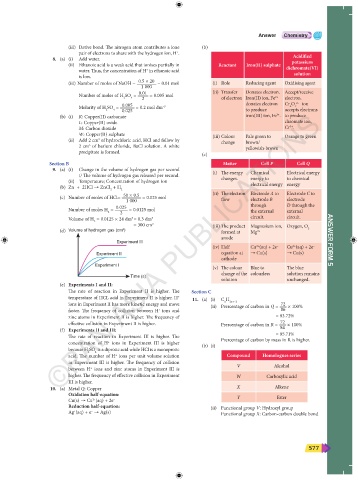
                     (c)  Number of moles of HCl=   50 × 0.5   = 0.025 mol  (ii)  The electron  Electrode A to  Electrode C to
                                          1 000                           flow     electrode B   electrode
                        Number of moles H  =   0.025   = 0.0125 mol                through     D through the
                                    2   2                                          the external   external
                        Volume of H  = 0.0125 × 24 dm = 0.3 dm 3                   circuit.    circuit.
                                            3
                                2
                                             = 300 cm 3                (iii) The product  Magnesium ion,  Oxygen, O
                                         3
                     (d)   Volume of hydrogen gas (cm )                   formed at   Mg 2+           2
                                                                          anode
                                       Experiment III                                                        ANSWER FORM 5
                                                                       (iv) Half   Cu (aq) + 2e   –  Cu (aq) + 2e   –
                                                                                                 2+
                                                                                     2+
                                 Experiment II                            equation at   → Cu(s)  → Cu(s)
                                                                          cathode
                                Experiment I                           (v)  The colour   Blue to   The blue
                                                                          change of the  colourless  solution remains
                                            Time (s)                      solution             unchanged.
                     (e)  Experiments I and II:
                        The rate of reaction in Experiment II is higher. The   Section C
                       temperature of HCL acid in Experiment II is higher. H   +   11.  (a)  (i)  C H
                                                                            2n + 2
                                                                           n
                       ions in Experiment II has more kinetic energy and move   (ii)  Prercentage of carbon in Q =   72   × 100%
                                                     +
                       faster. The frequency of collision between H  ions and                86
                       zinc atoms in Experiment II is higher. The frequency of             = 83.72%
                       effective collision in Experiment II is higher.     Prercentage of carbon in R =   72   × 100%
                     (f)  Experiments II and III:                                            84
                                                                                           = 85.71%
                        The rate of reaction in Experiment III is higher. The          Prercentage of carbon by mass in R is higher.
                       concentration of H  ions in Experiment III is higher   (b)  (i)
                                    +
                       because H SO  is a diprotic acid while HCl is a monoprotic
                                4
                              2
                                       +
                       acid. The number of H  ions per unit volume solution   Compound  Homologues series
                       in Experiment III is higher. The frequency of collision
                       between H  ions and zinc atoms in Experiment III is     V           Alcohol
                               +
                       higher. The frequency of effective collision in Experiment   W   Carboxylic acid
                       III is higher.
                  10.  (a)  Metal Q: Copper                                    X           Alkene
                        Oxidation half-equation:                               Y            Ester
                       Cu(s) → Cu (aq) + 2e –
                               2+
                        Reduction half-equation:                      (ii)  Functional group V: Hydroxyl group
                               –
                       Ag (aq) + e  → Ag(s)                              Functional group X: Carbon-carbon double bond
                         +
                                                                                                      577

