Page 22 - 1202 Question Bank Chemistry Form 5 KSSM
P. 22
2+
                   (ii)  Set I:  Iron(II) ion, Fe                       Discussion:
                      Set II: Iodide ion, I −                           Potassium  hexacyanoferrate(III)  solution  confirms  the
                   (iii) Set I:  Fe (aq) → Fe (aq) + e                  presence of Fe  ions which are produced when iron rusts.
                            2+
                                         −
                                                                                 2+
                                   3+
                           −
                      Set II: 2I (aq) → I (aq) + 2e −                   The  more  the  dark  blue  spots  formed,  the  higher  the
                                 2
                                                                        corrosion of iron. Phenolphthalein detects the presence of
                                                                        OH   ions  which  are  produced  at  the  cathode  during  the
                                                                          −
             Section C                                                  corrosion  of  metals.  The  higher  the  intensity  of  the  pink
                                                                        colour, the greater the extent of rusting of iron. A metal more
              10.  (a) Iron undergoes oxidation at the anode:

                          2+
                   Fe(s)→ Fe (aq) + 2e −                                electropositive than iron can protect the iron from rusting. A
                                                                        less electropositive metal than iron speeds up the corrosion
                   Electrons flow through iron to the cathode (edge of water
                                                                        of iron.
                   droplet). Oxygen is reduced to hydroxide ion, OH .
                                                   −
                      ©PAN ASIA PUBLICATIONS
                             −
                   O  + 2H O + 4e  → 4OH
                    2   2                                       11.  (a) (i)  Solution X in Set I:  Dilute hydrochloric acid
                                     −
                   Fe  ions combined with OH  ions to form a green precipitate,   At the anode, the E  value of OH  is less positive that the
                    2+
                                                                                    0
                                                                                             –
                   iron(II) hydroxide.                                  E  value of Cl . Oxidation of water to O  gas occurs more
                                                                         0
                                                                                 –
                                                                                                 2
                   Fe (aq) + 2OH (aq) → Fe(OH) (s)                      readily.
                             −
                    2+
                                       2
                   Further oxidation by oxygen, produced brown precipitate,   Oxygen gas is colourless.
                   hydrated iron(III) oxide or rust.                    Solution X in Set II:  Concentrated hydrochloric acid
                          oxidation
                   Fe(OH )(s) ⎯⎯⎯→ Fe O .xH O(s)                        At the anode, the concentration of Cl  ion is higher than
                                                                                                −
                       2           2  3  2
                                                                          –
                                                                                        −
                (b) (i)  Metal X: Magnesium                             OH  ion. Oxidation of Cl  to Cl  gas occurs more readily.
                                                                                            2
                      Metal Y: Lead                                     Chlorine gas is yellow-green.
                                                                                 −
                                                                         +
                      Magnesium is more electropositive than iron.   (ii)  H  ions and Cl  ions
                      Magnesium is more likely to release electrons compared   (iii) Set I:  Anode: 4OH (aq) → O (g) + 2H2O(l) + 4e   −
                                                                                    −
                                                                                          2
                      to iron and oxidised.                                Cathode: 2H (aq) + 2e  → H (g)
                                                                                          −
                                                                                    +
                              2+
                      Mg(s) → Mg (aq) + 2e −                                                  2
                                                                        Set II:  Anode: 2Cl (aq) → Cl (g) + 2e   −
                                                                                   −
                                                                                          2
                      Magnesium preventing iron from rusting. While lead is   Cathode: 2H (aq) + 2e  → H (g)
                                                                                          −
                                                                                    +
                                                                                               2
                      less electropositive than iron. Iron releases electrons and
                                                                  (b) Metal P:  Iron (Fe); Metal Q:  Copper (Cu); Metal R:  Zinc (Zn)
                      oxidised. Iron will rusts.                     P:  Iron(II) nitrate; Q:  Copper(II) nitrate; R:  Zinc nitrate
                             2+
                      Fe(s) → Fe (aq) + 2e −
                                                                     (i)  Materials:  Zinc  foil,  iron  foil,  iron(II)  nitrate  solution,
                   (ii)  Procedure:
                                                                               copper(II) nitrate solution
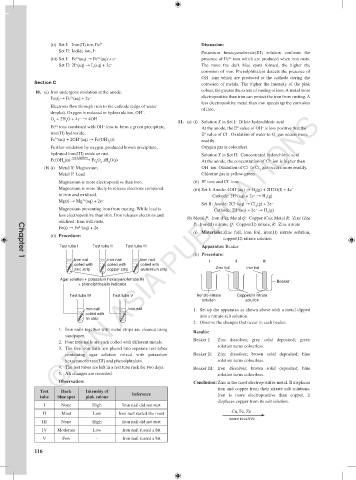
                      Test tube I  Test tube II  Test tube III          Apparatus: Beaker
                                                                     (ii)  Procedure:
                           Iron nail   Iron nail  Iron nail
                                                                          I        II        III
        Chapter 1
                           coiled with  coiled with  coiled with
                           zinc strip  copper strip  aluminium strip         Zinc foil  Iron foil
                      Agar solution + potassium hexacyanoferrate(III)
                                                                                                  Beaker
                            + phenolphthalein indicator
                         Test tube IV   Test tube V                   Iron(II) nitrate  Copper(II) nitrate
                                                                        solution       solution
                               Iron nail      Iron nail              1.  Set up the apparatus as shown above with a metal dipped
                               coiled with                             into a nitrate salt solution.
                               tin strip
                                                                     2.  Observe the changes that occur in each beaker.
                      1.  Iron nails together with metal strips are cleaned using
                                                                     Results:
                        sandpaper.
                                                                     Beaker I:     Zinc  dissolves;  grey  solid  deposited;  green
                      2.  Four iron nails are each coiled with different metals.
                                                                             solution turns colourless.
                      3.  The five iron nails are placed into separate test tubes
                        containing  agar  solution  mixed  with  potassium      Beaker II:   Zinc  dissolves;  brown  solid  deposited;  blue
                        hexacyanoferrate(III) and phenolphtalein.            solution turns colourless.
                      4.  The test tubes are left in a test tube rack for two days.     Beaker III:   Iron  dissolves;  brown  solid  deposited;  blue
                      5.  All changes are recorded.                          solution turns colourless.
                      Observation:                                   Conclusion:  Zinc is the most electropositive metal. It displaces
                                                                             iron and copper from their nitrate salt solutions.
               Test   Dark     Intensity of    Inference
               tube  blue spot  pink colour                                  Iron  is  more  electropositive  than  copper.  It
                                                                             displaces copper from its salt solution.
                I      None      High       Iron nail did not rust
                                                                                  Cu, Fe, Zn
                II     Most       Low      Iron nail rusted the most
                                                                                  more reactive
                III    None      High       Iron nail did not rust
                IV   Moderate     Low       Iron nail rusted a bit
                V      Few         -        Iron nail rusted a bit
             116
   17   18   19   20   21   22   23