


Page 5 - 1202 Question Bank Mathematics Form 4
P. 5
Quadratic Functions and
                      Chapter           1              Equations in One Variable


                  NOTes


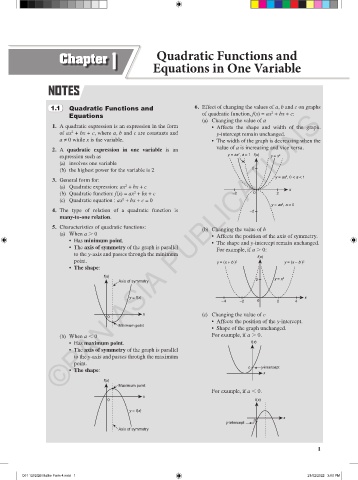
                   1.1   Quadratic Functions and                       6.  Effect of changing the values of a, b and c on graphs
                          Equations                                      of quadratic function, f(x) = ax  + bx + c:
                                                                                                 2
                      ©PAN ASIA PUBLICATIONS
                                                                         (a)  Changing the value of a
                    1.  A quadratic expression is an expression in the form   •  Affects  the  shape  and  width  of  the  graph.
                      of ax  + bx + c, where a, b and c are constants and     y-intercept remain unchanged.
                          2
                      a ≠ 0 while x is the variable.                        •  The width of the graph is decreasing when the
                    2.  A  quadratic expression in one variable is an         value of a is increasing and vice versa.
                                                                                     2
                      expression such as                                          y = ax , a > 1  f(x)  y = x 2
                      (a)  involves one variable
                      (b)  the highest power for the variable is 2                        2
                                                                                                      2
                                                                                                   y = ax , 0 < a < 1
                    3.  General form for:
                                             2
                      (a)  Quadratic expression: ax  + bx + c
                                                                                                       x
                                                 2
                      (b)  Quadratic function: f(x) = ax  + bx + c                 –2      0       2
                                            2
                      (c)  Quadratic equation : ax  + bx + c = 0
                                                                                                 y = ax , a < 0
                                                                                                     2
                    4.  The  type  of  relation  of  a  quadratic  function  is           –2
                      many-to-one relation.
                    5.  Characteristics of quadratic functions:
                                                                         (b)  Changing the value of b
                      (a)  When a . 0
                                                                            •  Affects the position of the axis of symmetry.
                          •  Has minimum point.
                                                                            •  The shape and y-intercept remain unchanged.
                          •  The axis of symmetry of the graph is parallel
                                                                              For example, if a . 0:
                           to the y-axis and passes through the minimum
                                                                                            f(x)
                           point.                                             y = (x + b ) 2          y = (x – b ) 2
                          •  The shape:
                                      f(x)                                                        y = x 2
                                           Axis of symmetry                                 2
                                               y = f(x)                                                      x
                                                                                –4    –2    0      2      4
                                                    x                    (c)  Changing the value of c
                                       0
                                                                            •  Affects the position of the y-intercept.
                                           Minimum point
                                                                            •  Shape of the graph unchanged.
                      (b)  When a , 0                                       For example, if a . 0.
                          •  Has maximum point.                                           f(x)
                          •  The axis of symmetry of the graph is parallel
                           to the y-axis and passes through the maximum
                           point.
                                                                                         c    y-intercept
                          •  The shape:
                                                                                              x
                                      f(x)
                                           Maximum point
                                                                            For example, if a , 0.
                                                    x
                                       0                                                   f(x)
                                               y = f(x)
                                                                                                     x
                                                                                           0
                                                                                 y-intercept  c
                                           Axis of symmetry


                                                                                                                  1


         C01 1202QB Maths Form 4.indd   1                                                                     21/02/2022   3:00 PM

