


Page 82 - KSN English Final
P. 82
In this regard, infrastructure projects shall remain relevant in PPP, albeit
               (iii)  PFI in Education                                                                 with  focus  on  new  areas  such  as  green  technology,  energy-efficient
                                                                                                       design, opening up of new and strategic townships and cities, and sectors
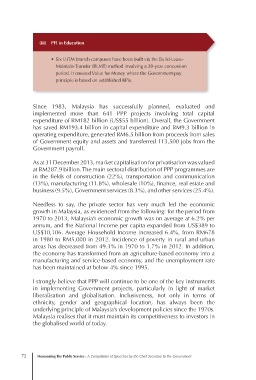
                   • Six UiTM branch campuses have been built via the Build-Lease-                     which generate high spill-over effects.
                     Maintain-Transfer (BLMT) method involving a 20-year concession
                     period. It ensured Value for Money where the Government-pay                       It must be noted that PPP is only possible through smart partnership
                     principle is based on established KPIs.                                           ventures between the private and public sector, with a high level of
                                                                                                       commitment from the Government. The Government’s commitment is
                                                                                                       clearly  manifested  not  only  through  Malaysia’s  five  year  development
                                                                                                       plans, where privatisation or PPP has been one of its significant features,
            Since 1983, Malaysia has successfully planned, evaluated and                               but also with the establishment of UKAS and the RM20 billion Facilitation
            implemented more than 641 PPP projects involving total capital                             Fund to encourage private sector investment in strategic key economic
            expenditure of RM182 billion (US$55 billion). Overall, the Government                      areas.
            has saved RM193.4 billion in capital expenditure and RM9.3 billion in
            operating expenditure, generated RM6.5 billion from proceeds from sales                    In recognising the importance of PPP, I have outlined Public Private
            of Government equity and assets and transferred 113,500 jobs from the                      Partnership as one of the six principles in  Merakyatkan Perkhidmatan
            Government payroll.                                                                        Awam or “Humanising the Public Service”. In this principle, the
                                                                                                       Government and private sector work in smart partnership in enhancing
            As at 31 December 2013, market capitalisation for privatisation was valued                 and transforming public service delivery for mutual benefits.
            at RM287.9 billion. The main sectoral distribution of PPP programmes are
            in the fields of construction (22%), transportation and communication                      As I have explained, PPP has been implemented in Malaysia for more
            (13%), manufacturing (11.8%), wholesale (10%), finance, real estate and                    than 30 years and has contributed significantly towards Malaysia’s rapid
            business (9.5%), Government services (8.3%), and other services (25.4%).                   economic growth. With this in mind, Malaysia is ever-willing to share
                                                                                                       our experience in PPP implementation with other countries, particularly
            Needless to say, the private sector has very much led the economic                         developing countries that are interested to learn the best practices from
            growth in Malaysia, as evidenced from the following: for the period from                   Malaysia and emulate our humble successes. Hence, I would like to urge
            1970 to 2013, Malaysia’s economic growth was on average at 6.2% per                        our friends to take advantage of the capacity building, consultancy and
            annum, and the National Income per capita expanded from US$389 to                          advisory  programmes  offered  by  the  PPP  Centre  of  Excellence  under
            US$10,106. Average Household Income increased 6.4%, from RM678                             UKAS.
            in 1980 to RM5,000 in 2012. Incidence of poverty in rural and urban
            areas has decreased from 49.3% in 1970 to 1.7% in 2012. In addition,                       The interest and demand in PPPs have been growing in recent years across
            the economy has transformed from an agriculture-based economy into a                       the world and the need for fiscal restraint in some countries is expected
            manufacturing and service-based economy, and the unemployment rate                         to further increase their use. As such, Malaysia is now looking into ways
            has been maintained at below 4% since 1995.                                                to  minimise  the  fiscal  risks  to  the  Government  without  jeopardising
                                                                                                       incentives to the private sector in PPP. This may be by way of developing
            I strongly believe that PPP will continue to be one of the key instruments                 a set of public sector indicators in the assessment of PPP projects and
            in implementing Government projects, particularly in light of market                       implementing  innovative  PPPs  which  efficiently  utilise  Government
            liberalisation  and  globalisation.  Inclusiveness,  not  only  in  terms  of              expenditure.
            ethnicity, gender and geographical location, has always been the
            underlying principle of Malaysia’s development policies since the 1970s.
            Malaysia realises that it must maintain its competitiveness to investors in
            the globalised world of today.


        72    Humanising The Public Service : A Compilation of Speeches by the Chief Secretary to the Government                                                        73

