


Page 338 - Hunter - The Vigil
P. 338
F
                                                                                  R
                                                                              .
                                                                          |
                                                                            B
                                                                                          L
                                                                                                                R
                                                                                                                R
                                                                                                              E
                                                                                                            T
                                                                                                              E
                                                                          |
                                                              L
                                                                U
                                                      R REVOLUTION|B.FRANKLIN, PRINTER
                                                          V
                                                            O
                                                                  T
                                                                        N
                                                                        N
                                                                      O
                                                                    I
                                                                      O
                                                                                                                R
            Continental Congresses held their sessions, and where strategy     B. Franklin, Printer
            for the War of Independence was planned, the city was a high-
                                                                  It’s hard to imagine an America, let alone a Philadelphia,
            priority target for British forces. Battles fought in and around
                                                              without Benjamin Franklin. Aside from his critical role as a
            the city included the Battle of Brandywine in 1777, after
                                                              founding father and statesman — it was his diplomacy that
            which the city was occupied by the British. The founding
                                                              convinced France to ally with the colonies against the British,
            fathers bolted, the famous Liberty Bell was evacuated (to keep
                                                              just as one example — Franklin left an indelible mark on his
            the British from melting it down into bullets) and the city

                                                              city, creating everything from its first volunteer fire company

            was stripped of anything that might be of value to the enemy:
                                                              to the University of Pennsylvania. Here are some suggestions
            blankets, clothing, cattle, food. Philadelphia’s residents found
                                                              for storytellers who’d like to reference one of Philadelphia’s
            themselves trapped in a city overcrowded with refugees and
                                                              greatest icons in their chronicles:
            British troops; a blockade by American forces kept supplies
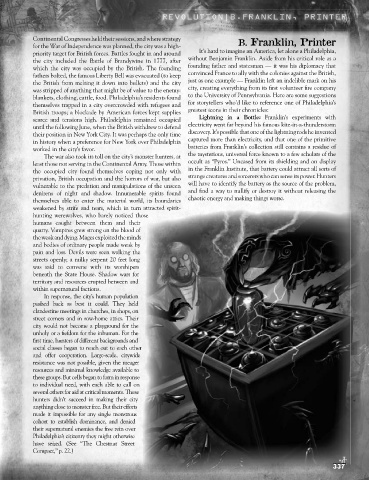
                                                                  Lightning in a Bottle: Franklin’s experiments with
            scarce and tensions high. Philadelphia remained occupied
                                                              electricity went far beyond his famous kite-in-a-thunderstorm
            until the following June, when the British withdrew to defend
                                                              discovery. It’s possible that one of the lightning rods he invented
            their position in New York City. It was perhaps the only time
                                                              captured more than electricity, and that one of the primitive
            in history when a preference for New York over Philadelphia
                                                              batteries from Franklin’s collection still contains a residue of
            worked in the city’s favor.
                                                              the mysterious, universal force known to a few scholars of the
               The war also took its toll on the city’s monster hunters, at
                                                              occult as “Pyros.” Uncased from its shielding and on display
            least those not serving in the Continental Army. Those within
                                                              in the Franklin Institute, that battery could attract all sorts of
            the occupied city found themselves coping not only with
                                                              strange creatures and sorcerers who can sense its power. Hunters
            privation, British occupation and the horrors of war, but also
                                                              will have to identify the battery as the source of the problem,
            vulnerable to the predation and manipulations of the unseen

                                                              and find a way to nullify or destroy it without releasing the
            denizens of night and shadow. Innumerable spirits found
                                                              chaotic energy and making things worse.
            themselves able to enter the material world, its boundaries
                                                attracted

                                              n
                                                        spirit

            weakened by strife and tears, which in turn attracted spirit-
            hunting werewolves, who barely noticed those
                                              h
                                               o
                                                se
            humans caught between them and their
            quarry. Vampires grew strong on the blood of
                                              f
                                              s
            the weak and dying. Mages exploited the minds
            and bodies of ordinary people made weak by
            pain and loss. Devils were seen walking the
            streets openly; a milky serpent 20 feet long
            was said to convene with its worshipers
            beneath the State House. Shadow wars for
            territory and resources erupted between and
            within supernatural factions.
               In response, the city’s human population
            pushed back as best it could. They held
            clandestine meetings in churches, in shops, on
            street corners and in row-home attics. Their
            city would not become a playground for the
            unholy or a fiefdom for the inhuman. For the

            first time, hunters of different backgrounds and

                                               r
            social classes began to reach out to each other
            and offer cooperation. Large-scale, citywide
            resistance was not possible, given the meager
            resources and minimal knowledge available to
            these groups. But cells began to form in response
            to individual need, with each able to call on
            several others for aid at critical moments. These
            hunters didn’t succeed in making their city
            anything close to monster free. But their efforts
            made it impossible for any single monstrous
            cohort to establish dominance, and denied
            their supernatural enemies the free rein over
            Philadelphia’s citizenry they might otherwise
            have seized. (See “The Chestnut Street
            Compact,” p. 22.)
                                                                                                              337
                                                                                                              337

