


Page 125 - Towards Trustworthy Elections New Directions in Electronic Voting by Ed Gerck (auth.), David Chaum, Markus Jakobsson, Ronald L. Rivest, Peter Y. A. Ryan, Josh Benaloh, Miroslaw Kutylowski, Ben Adida ( (z-lib.org (1)
P. 125
Unconditionally Secure Electronic Voting
                                                                                            117
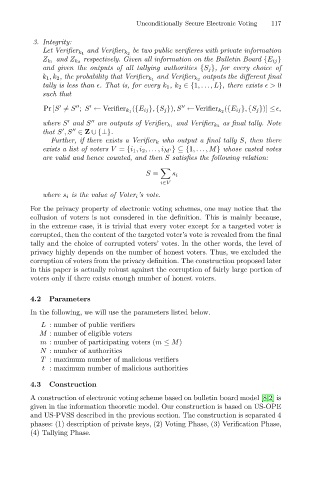
                           3. Integrity:
                                                      be two public verifieres with private information
                             Let Verifier k 1
                                         and Verifier k 2
                                         respectively. Given all information on the Bulletin Board {E ij }
                                 and Z k 2
                             Z k 1
                             and given the outputs of all tallying authorities {S j }, for every choice of
                                                                         outputs the different final
                             k 1 ,k 2 , the probability that Verifier k 1  and Verifier k 2
                             tally islessthan  . That is, for every k 1 , k 2 ∈{1,...,L},there exists  > 0
                             such that

                              Pr [S  = S ; S ← Verifier k 1  ({E ij }, {S j }),S ←Verifier k 2 ({E ij }, {S j })] ≤ ,
                                                                               as final tally. Note
                             where S and S are outputs of Verifier k 1  and Verifier k 2
                             that S ,S ∈ Z ∪{⊥}.


                                Further, if there exists a Verifier k who output a final tally S, then there
                             exists a list of voters V = {i 1 ,i 2,...,i M  }⊆ {1,...,M} whose casted votes
                             are valid and hence counted, and then S satisfies the following relation:

                                                          S =    s i
                                                              i∈V
                             where s i is the value of Voter i ’s vote.
                          For the privacy property of electronic voting schemes, one may notice that the
                          collusion of voters is not consdered in the definition. This is mainly because,
                          in the extreme case, it is trivial that every voter except for a targeted voter is
                          corrupted, then the content of the targeted voter’s vote is revealed from the final
                          tally and the choice of corrupted voters’ votes. In the other words, the level of
                          privacy highly depends on the number of honest voters. Thus, we excluded the
                          corruption of voters from the privacy definition. The construction proposed later
                          in this paper is actually robust against the corruption of fairly large portion of
                          voters only if there exists enough number of honest voters.

                          4.2  Parameters
                          In the following, we will use the parameters listed below.
                             L : number of public verifiers
                            M : number of eligible voters
                             m : number of participating voters (m ≤ M)
                             N : number of authorities
                             T : maximum number of malicious verifiers
                             t : maximum number of malicious authorities
                          4.3  Construction

                          A construction of electronic voting scheme based on bulletin board model [8,2] is
                          given in the information theoretic model. Our construction is based on US-OPE
                          and US-PVSS described in the previous section. The construction is separated 4
                          phases: (1) description of private keys, (2) Voting Phase, (3) Verification Phase,
                          (4) Tallying Phase.

