


Page 127 - Towards Trustworthy Elections New Directions in Electronic Voting by Ed Gerck (auth.), David Chaum, Markus Jakobsson, Ronald L. Rivest, Peter Y. A. Ryan, Josh Benaloh, Miroslaw Kutylowski, Ben Adida ( (z-lib.org (1)
P. 127
Unconditionally Secure Electronic Voting
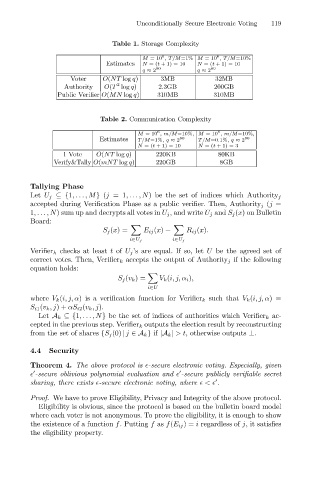
                                                Table 1. Storage Complexity
                                                                             6
                                                         M =10 , T/M=1% M =10 , T/M=10%
                                               Estimates
                                                         N =(t +1) = 10
                                                                            80
                                                            80  6       N =(t +1) = 10      119
                                                         q ≈ 2          q ≈ 2
                                     Voter    O(NT log q)     3MB            32MB
                                                  2
                                   Authority  O(T log q)     2.3GB           200GB
                                 Public Verifier O(MN log q)  310MB          310MB
                                             Table 2. Communication Complexity
                                                             6                6
                                                       M =10 , m/M=10%, M =10 , m/M=10%,
                                             Estimates  T/M=1%, q ≈ 2 80  T/M=0.1%, q ≈ 2 80
                                                       N =(t +1) = 10   N =(t +1) = 3
                                   1Vote    O(NT log q)     220KB             80KB
                                Verify&Tally O(mNT log q)   220GB             8GB
                          Tallying Phase
                          Let U j ⊆{1,... ,M} (j =1,... ,N) be the set of indices which Authority j
                          accepted during Verification Phase as a public verifier. Then, Authority j (j =
                          1,... ,N) sum up and decrypts all votes in U j ,and write U j and S j (x) on Bulletin
                          Board:

                                              S j (x)=   E ij (x) −  R ij (x).
                                                     i∈U j       i∈U j
                          Verifier k checks at least t of U j ’s are equal. If so, let U be the agreed set of
                          correct votes. Then, Verifier k accepts the output of Authority j if the following
                          equation holds:

                                                  S j (v k )=  V k (i, j, α i ),
                                                          i∈U
                          where V k (i, j, α) is a verification function for Verifier k such that V k (i, j, α)=
                          S i1 (v k ,j)+ αS i2 (v k ,j).
                            Let A k ⊆{1,... ,N} be the set of indices of authorities which Verifier k ac-
                          cepted in the previous step. Verifier k outputs the election result by reconstructing
                          from the set of shares {S j (0) | j ∈A k } if |A k | >t, otherwise outputs ⊥.
                          4.4  Security

                          Theorem 4. The above protocol is  -secure electronic voting. Especially, given
                            -secure oblivious polynomial evaluation and   -secure publicly verifiable secret


                          sharing, there exists  -secure electronic voting, where  <   .
                          Proof. We have to prove Eligibility, Privacy and Integrity of the above protocol.
                            Eligibility is obvious, since the protocol is based on the bulletin board model
                          where each voter is not anonymous. To prove the eligibility, it is enough to show
                          the existence of a function f. Putting f as f(E ij )= i regardless of j,it satisfies
                          the eligibility property.

