


Page 228 - Towards Trustworthy Elections New Directions in Electronic Voting by Ed Gerck (auth.), David Chaum, Markus Jakobsson, Ronald L. Rivest, Peter Y. A. Ryan, Josh Benaloh, Miroslaw Kutylowski, Ben Adida ( (z-lib.org (1)
P. 228
H. Jonker and W. Pieters
                          220
                          in Section 2.2. Objective trees are attack trees (see [19,13]), but focus upon
                          meeting goals instead of achieving attacks.
                            Our objective tree deviates slightly from normal attack trees. The purpose of
                          our tree is to determine characteristics that distinguish acceptable from unac-
                          ceptable influence. To elucidate these detailed characteristics, details need to be
                          explicit in the tree. Hence, where normally attributes would be used, we promote
                          these characteristics to leaves. This makes these characteristics explicit.
                          2.2  Classifying Vote Buying
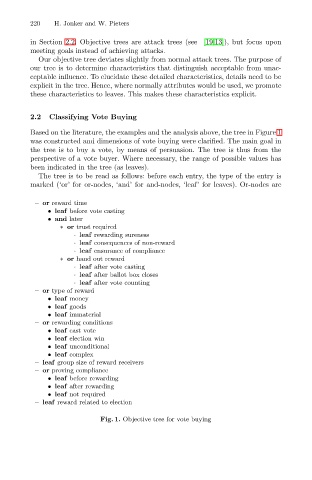
                          Based on the literature, the examples and the analysis above, the tree in Figure 1
                          was constructed and dimensions of vote buying were clarified. The main goal in
                          the treeistobuy avote, by meansof persuasion. The treeisthusfrom the
                          perspective of a vote buyer. Where necessary, the range of possible values has
                          been indicated in the tree (as leaves).
                            The tree is to be read as follows: before each entry, the type of the entry is
                          marked (‘or’ for or-nodes, ‘and’ for and-nodes, ‘leaf’ for leaves). Or-nodes are

                           –or reward time
                               • leaf before vote casting
                               • and later
                                  ∗ or trust required
                                      · leaf rewarding sureness
                                      · leaf consequences of non-reward
                                      · leaf ensurance of compliance
                                  ∗ or hand out reward
                                      · leaf after vote casting
                                      · leaf after ballot box closes
                                      · leaf after vote counting
                           –or type of reward
                               • leaf money
                               • leaf goods
                               • leaf immaterial
                           –or rewarding conditions
                               • leaf cast vote
                               • leaf election win
                               • leaf unconditional
                               • leaf complex
                           –leaf group size of reward receivers
                           –or proving compliance
                               • leaf before rewarding
                               • leaf after rewarding
                               • leaf not required
                           –leaf reward related to election
                                             Fig. 1. Objectivetreefor vote buying

