


Page 233 - Towards Trustworthy Elections New Directions in Electronic Voting by Ed Gerck (auth.), David Chaum, Markus Jakobsson, Ronald L. Rivest, Peter Y. A. Ryan, Josh Benaloh, Miroslaw Kutylowski, Ben Adida ( (z-lib.org (1)
P. 233
225
                                                               Anonymity in Voting Revisited
                           – rewarding the voter if she does not vote for a specific party or candidate
                             (related to negative proof);
                           – rewarding the voter if it is likely that she made a certain choice.
                          It can be enough for a buyer to hand out the reward if a voter can show that she
                          did not vote for two of the buyer’s opponents (example 6). The buyer could also
                          pay a voter if after observing the outcome, it is more likely that this voter voted
                          for him than that another voter voted for him. If this can be observed from
                          messages sent in the voting protocol, this should be addressed by computer
                          science verification methods. One could also derive this from voter behaviour
                          [4], but that is hard to prevent using computer science tools.
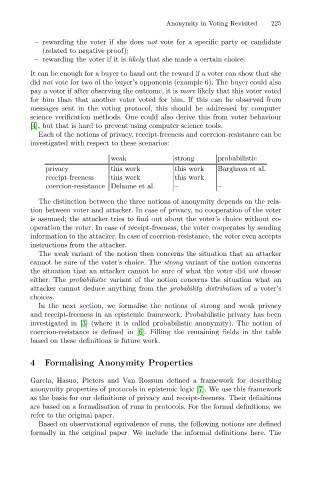
                            Each of the notions of privacy, receipt-freeness and coercion-resistance can be
                          investigated with respect to these scenarios:
                                                weak              strong      probabilistic
                              privacy           this work         this work   Barghava et al.
                              receipt-freeness  this work         this work   –
                              coercion-resistance Delaune et al.  –           –

                            The distinction between the three notions of anonymity depends on the rela-
                          tion between voter and attacker. In case of privacy, no cooperation of the voter
                          is assumed; the attacker tries to find out about the voter’s choice without co-
                          operation the voter. In case of receipt-freeness, the voter cooperates by sending
                          information to the attacker. In case of coercion-resistance, the voter even accepts
                          instructions from the attacker.
                            The weak variant of the notion then concerns the situation that an attacker
                          cannot be sure of the voter’s choice. The strong variant of the notion concerns
                          the situation that an attacker cannot be sure of what the voter did not choose
                          either. The probabilistic variant of the notion concerns the situation what an
                          attacker cannot deduce anything from the probability distribution of a voter’s
                          choices.
                            In the next section, we formalise the notions of strong and weak privacy
                          and receipt-freeness in an epistemic framework. Probabilistic privacy has been
                          investigated in [3] (where it is called probabilistic anonymity). The notion of
                          coercion-resistance is defined in [6]. Filling the remaining fields in the table
                          based on these definitions is future work.

                          4   Formalising Anonymity Properties


                          Garcia, Hasuo, Pieters and Van Rossum defined a framework for describing
                          anonymity properties of protocols in epistemic logic [7]. We use this framework
                          as the basis for our definitions of privacy and receipt-freeness. Their definitions
                          are based on a formalisation of runs in protocols. For the formal definitions, we
                          refer to the original paper.
                            Based on observational equivalence of runs, the following notions are defined
                          formally in the original paper. We include the informal definitions here. The

