


Page 236 - Towards Trustworthy Elections New Directions in Electronic Voting by Ed Gerck (auth.), David Chaum, Markus Jakobsson, Ronald L. Rivest, Peter Y. A. Ryan, Josh Benaloh, Miroslaw Kutylowski, Ben Adida ( (z-lib.org (1)
P. 236
H. Jonker and W. Pieters
                          228
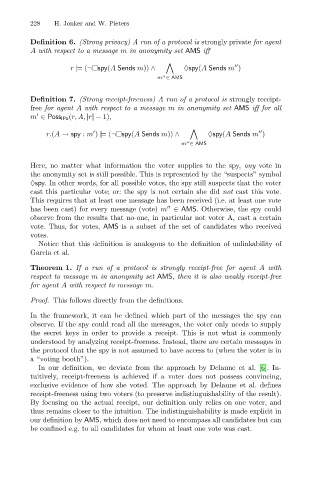
                          Definition 6. (Strong privacy) A run of a protocol is strongly private for agent
                          A with respect to a message m in anonymity set AMS iff

                                     r |=(¬ spy(A Sends m)) ∧       ♦spy(A Sends m )
                                                             m    ∈ AMS
                          Definition 7. (Strong receipt-freeness) A run of a protocol is strongly receipt-
                          free for agent A with respect to a message m in anonymity set AMS iff for all
                          m ∈ Poss IPo (r, A, |r|− 1),


                              r.(A → spy : m ) |=(¬ spy(A Sends m)) ∧      ♦spy(A Sends m )
                                                                   m    ∈ AMS
                          Here, no matter what information the voter supplies to the spy, any vote in
                          the anonymity set is still possible. This is represented by the “suspects” symbol
                          ♦spy. In other words, for all possible votes, the spy still suspects that the voter
                          cast this particular vote; or: the spy is not certain she did not cast this vote.
                          This requires that at least one message has been received (i.e. at least one vote
                          has been cast) for every message (vote) m ∈ AMS.Otherwise,the spycould

                          observe from the results that no-one, in particular not voter A, cast a certain
                          vote. Thus, for votes, AMS is a subset of the set of candidates who received
                          votes.
                            Notice that this definition is analogous to the definition of unlinkability of
                          Garcia et al.
                          Theorem 1. If a run of a protocol is strongly receipt-free for agent A with
                          respect to message m in anonymity set AMS, then it is also weakly receipt-free
                          for agent A with respect to message m.

                          Proof. This follows directly from the definitions.
                          In the framework, it can be defined which part of the messages the spy can
                          observe. If the spy could read all the messages, the voter only needs to supply
                          the secret keys in order to provide a receipt. This is not what is commonly
                          understood by analyzing receipt-freeness. Instead, there are certain messages in
                          the protocol that the spy is not assumed to have access to (when the voter is in
                          a “voting booth”).
                            In our definition, we deviate from the approach by Delaune et al. [6]. In-
                          tuitively, receipt-freeness is achieved if a voter does not possess convincing,
                          exclusive evidence of how she voted. The approach by Delaune et al. defines
                          receipt-freeness using two voters (to preserve indistinguishability of the result).
                          By focusing on the actual receipt, our definition only relies on one voter, and
                          thus remains closer to the intuition. The indistinguishability is made explicit in
                          our definition by AMS, which does not need to encompass all candidates but can
                          be confined e.g. to all candidates for whom at least one vote was cast.

