


Page 266 - Towards Trustworthy Elections New Directions in Electronic Voting by Ed Gerck (auth.), David Chaum, Markus Jakobsson, Ronald L. Rivest, Peter Y. A. Ryan, Josh Benaloh, Miroslaw Kutylowski, Ben Adida ( (z-lib.org (1)
P. 266
S. Popoveniuc and B. Hosp
                          258
                          symbols on the bottom page, the election authority only needs to generate two
                          random numbers between 1 and c, and record these numbers as P 1 and P 2 to
                          indicate the shift distance for the pages of ballot x.
                            Each D-matrix instance will require its own set of decrypting mark permu-
                          tations (columns D 2 and D 4 ). (It is for this reason that at least the decrypting
                          mark permutations must be performed after the row permutations.) For each
                                       i
                          row of each D , the election authority generates a random number between 1
                                                              i
                                                          i
                          and c, and records this number in D . D is set such that the modular sum of
                                                          2
                                                              4
                          the ballot’s entries in P 1 and P 2 equals the sum of its entries in D 2 and D 4 .
                          Random Number Generation. The permutation algorithm described above
                          can also be used for the random number generation. The election authority can
                          compute a permutation π of 1, 2,...,c and use π(1) as the random number.
                          B   Commitments
                          This section describes how the commitments in PunchScan are computed. We
                          use the comma (“,”) to represent the concatenation operation. There are two
                          secret AES 128-bit keys, MK 1 and MK 2, and a public 128-bit constant, C.

                          B.1   Computing AES Keys

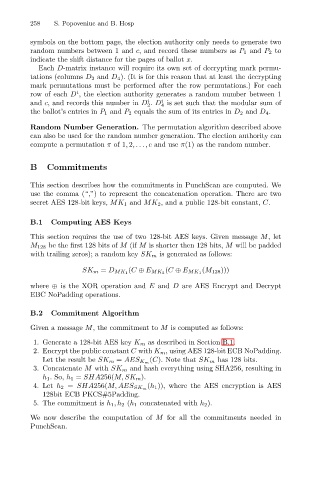
                          This section requires the use of two 128-bit AES keys. Given message M,let
                          M 128 be the first 128 bits of M (if M is shorter then 128 bits, M will be padded
                          with trailing zeros); a random key SK m is generated as follows:

                                                                         (M 128 )))
                                        SK m = D MK 1  (C ⊕ E MK 2  (C ⊕ E MK 1
                          where ⊕ is the XOR operation and E and D are AES Encrypt and Decrypt
                          EBC NoPadding operations.

                          B.2   Commitment Algorithm

                          Given a message M, the commitment to M is computed as follows:
                           1. Generate a 128-bit AES key K m as described in Section B.1.
                           2. Encrypt the public constant C with K m, using AES 128-bit ECB NoPadding.
                                                           (C). Note that SK m has 128 bits.
                             Let the result be SK m = AES K m
                           3. Concatenate M with SK m and hash everything using SHA256, resulting in
                             h 1 .So, h 1 = SHA256(M, SK m).
                                                          (h 1 )), where the AES encryption is AES
                           4. Let h 2 = SHA256(M, AES SK m
                             128bit ECB PKCS#5Padding.
                           5. The commitment is h 1 ,h 2 (h 1 concatenated with h 2 ).
                          We now describe the computation of M for all the commitments needed in
                          PunchScan.

