


Page 262 - Towards Trustworthy Elections New Directions in Electronic Voting by Ed Gerck (auth.), David Chaum, Markus Jakobsson, Ronald L. Rivest, Peter Y. A. Ryan, Josh Benaloh, Miroslaw Kutylowski, Ben Adida ( (z-lib.org (1)
P. 262
S. Popoveniuc and B. Hosp
                          254
                               First Audit
                          7.3
                          The first audit procedure ensures that the ballots are well-formed, meaning that
                          for each ballot, P 1 ⊕P 2 = D 2 ⊕D 4 for the row in each D-matrix associated with
                          that ballot. This involves spoiling some fraction of the ballots by unlocking this
                          secret data.
                            In general, suppose there are n ballots, the election authority has cheated by
                          malforming k of them, and f ballots are chosen at random to be examined. The
                          probability that the election authority gets away with this attack is the number
                          of possibilities where the auditor chooses only valid vote divided by the number
                          of all possible choices.

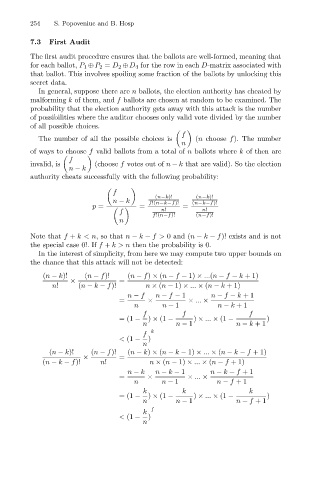
                                                                    f
                            The number of all the possible choices is  (n choose f). The number
                                                                    n
                          of ways to choose f valid ballots from a total of n ballots where k of then are

                                     f
                          invalid, is       (choose f votes out of n − k that are valid). So the election
                                     n − k
                          authority cheats successfully with the following probability:

                                                 f
                                                            (n−k)!      (n−k)!
                                                 n − k    f!(n−k−f)!  (n−k−f)!
                                           p =          =     n!    =    n!
                                                  f
                                                            f!(n−f)!    (n−f)!
                                                  n
                          Note that f + k< n,so that n − k − f> 0and (n − k − f)! exists and is not
                          the special case 0!. If f + k> n then the probability is 0.
                            In the interest of simplicity, from here we may compute two upper bounds on
                          the chance that this attack will not be detected:
                             (n − k)!    (n − f)!    (n − f) × (n − f − 1) × ...(n − f − k +1)
                                     ×            =
                                n!     (n − k − f)!       n × (n − 1) × ... × (n − k +1)
                                                     n − f  n − f − 1       n − f − k +1
                                                  =       ×          × ... ×
                                                      n       n − 1           n − k +1
                                                         f          f                 f
                                                  =(1 −   ) × (1 −     ) × ... × (1 −      )
                                                         n        n − 1            n − k +1
                                                         f  k
                                                  < (1 −  )
                                                         n
                               (n − k)!    (n − f)!  (n − k) × (n − k − 1) × ... × (n − k − f +1)
                                        ×         =
                             (n − k − f)!    n!            n × (n − 1) × ... × (n − f +1)
                                                     n − k  n − k − 1       n − k − f +1
                                                  =       ×          × ... ×
                                                      n       n − 1          n − f +1
                                                         k          k                 k
                                                  =(1 −   ) × (1 −     ) × ... × (1 −      )
                                                         n        n − 1            n − f +1
                                                         k  f
                                                  < (1 −  )
                                                         n

