


Page 347 - Towards Trustworthy Elections New Directions in Electronic Voting by Ed Gerck (auth.), David Chaum, Markus Jakobsson, Ronald L. Rivest, Peter Y. A. Ryan, Josh Benaloh, Miroslaw Kutylowski, Ben Adida ( (z-lib.org (1)
P. 347
339
                               A Practical and Secure Coercion-Resistant Scheme for Internet Voting
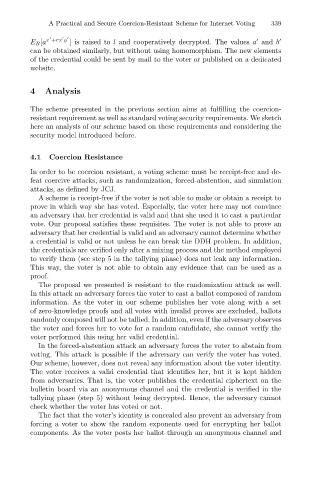
                              x +rx y


                          E R [a
                          can be obtained similarly, but without using homomorphism. The new elements
                          of the credential could be sent by mail to the voter or published on a dedicated
                          website.       ]israised to l and cooperatively decrypted. The values a and b
                          4   Analysis
                          The scheme presented in the previous section aims at fulfilling the coercion-
                          resistant requirement as well as standard voting security requirements. We sketch
                          here an analysis of our scheme based on these requirements and considering the
                          security model introduced before.
                          4.1  Coercion Resistance

                          In order to be coercion resistant, a voting scheme must be receipt-free and de-
                          feat coercive attacks, such as randomization, forced-abstention, and simulation
                          attacks, as defined by JCJ.
                            A scheme is receipt-free if the voter is not able to make or obtain a receipt to
                          prove in which way she has voted. Especially, the voter here may not convince
                          an adversary that her credential is valid and that she used it to cast a particular
                          vote. Our proposal satisfies these requisites. The voter is not able to prove an
                          adversary that her credential is valid and an adversary cannot determine whether
                          a credential is valid or not unless he can break the DDH problem. In addition,
                          the credentials are verified only after a mixing process and the method employed
                          to verify them (see step 5 in the tallying phase) does not leak any information.
                          This way, the voter is not able to obtain any evidence that can be used as a
                          proof.
                            The proposal we presented is resistant to the randomization attack as well.
                          In this attack an adversary forces the voter to cast a ballot composed of random
                          information. As the voter in our scheme publishes her vote along with a set
                          of zero-knowledge proofs and all votes with invalid proves are excluded, ballots
                          randomly composed will not be tallied. In addition, even if the adversary observes
                          the voter and forces her to vote for a random candidate, she cannot verify the
                          voter performed this using her valid credential.
                            In the forced-abstention attack an adversary forces the voter to abstain from
                          voting. This attack is possible if the adversary can verify the voter has voted.
                          Our scheme, however, does not reveal any information about the voter identity.
                          The voter receives a valid credential that identifies her, but it is kept hidden
                          from adversaries. That is, the voter publishes the credential ciphertext on the
                          bulletin board via an anonymous channel and the credential is verified in the
                          tallying phase (step 5) without being decrypted. Hence, the adversary cannot
                          check whether the voter has voted or not.
                            The fact that the voter’s identity is concealed also prevent an adversary from
                          forcing a voter to show the random exponents used for encrypting her ballot
                          components. As the voter posts her ballot through an anonymous channel and

