


Page 352 - Towards Trustworthy Elections New Directions in Electronic Voting by Ed Gerck (auth.), David Chaum, Markus Jakobsson, Ronald L. Rivest, Peter Y. A. Ryan, Josh Benaloh, Miroslaw Kutylowski, Ben Adida ( (z-lib.org (1)
P. 352
M. Kutyłowski and F. Zagórski
                          344
                            In this paper we are concerned with an E2E systems for remote voting over electronic
                          networks. We assume that the electronic devices used by a voter might be infected by
                          malicious code, and that voter’s privacy and election integrity must be guaranteed in a
                          verifiable way.
                          1.1 Related Work
                          Three important ideas concerning E2E voting systems have been presented during the
                          last few years: Prêt à Voter, Punchscan, ThreeBallot (and related schemes). All of them
                          are dedicated to paper-based elections at polling stations. Recently, Punchscan and Prêt
                          à Voter have been adjusted to mail-in voting [15]. Since these methods are closely re-
                          lated to our scheme, we recall them briefly.

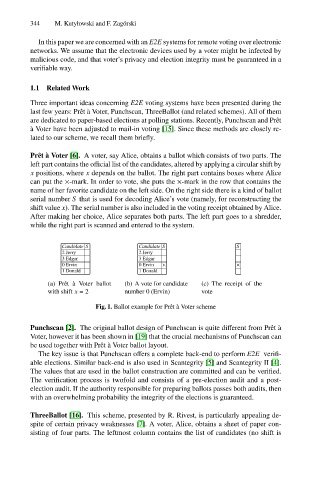
                          Prêt à Voter [6]. A voter, say Alice, obtains a ballot which consists of two parts. The
                          left part contains the official list of the candidates, altered by applying a circular shift by
                          x positions, where x depends on the ballot. The right part contains boxes where Alice
                          can put the ×-mark. In order to vote, she puts the ×-mark in the row that contains the
                          name of her favorite candidate on the left side. On the right side there is a kind of ballot
                          serial number S that is used for decoding Alice’s vote (namely, for reconstructing the
                          shift value x). The serial number is also included in the voting receipt obtained by Alice.
                          After making her choice, Alice separates both parts. The left part goes to a shredder,
                          while the right part is scanned and entered to the system.


                                   Candidate S          Candidate S                S
                                   2 Jerry              2 Jerry
                                   3 Edgar              3 Edgar
                                   0Ervin               0Ervin  ×                  ×
                                   1 Donald             1 Donald
                               (a) Prêt à Voter ballot  (b) A vote for candidate  (c) The receipt of the
                               with shift x = 2     number 0 (Ervin)     vote

                                            Fig. 1. Ballot example for Prêt à Voter scheme


                          Punchscan [2]. The original ballot design of Punchscan is quite different from Prêt à
                          Voter, however it has been shown in [19] that the crucial mechanisms of Punchscan can
                          be used together with Prêt à Voter ballot layout.
                            The key issue is that Punchscan offers a complete back-end to perform E2E verifi-
                          able elections. Similar back-end is also used in Scantegrity [5] and Scantegrity II [4].
                          The values that are used in the ballot construction are committed and can be verified.
                          The verification process is twofold and consists of a pre-election audit and a post-
                          election audit. If the authority responsible for preparing ballots passes both audits, then
                          with an overwhelming probability the integrity of the elections is guaranteed.


                          ThreeBallot [16]. This scheme, presented by R. Rivest, is particularly appealing de-
                          spite of certain privacy weaknesses [7]. A voter, Alice, obtains a sheet of paper con-
                          sisting of four parts. The leftmost column contains the list of candidates (no shift is

