


Page 354 - Towards Trustworthy Elections New Directions in Electronic Voting by Ed Gerck (auth.), David Chaum, Markus Jakobsson, Ronald L. Rivest, Peter Y. A. Ryan, Josh Benaloh, Miroslaw Kutylowski, Ben Adida ( (z-lib.org (1)
P. 354
M. Kutyłowski and F. Zagórski
                          346
                          Version 2: In order to balance the number of × marks in the columns (in order to make
                             the scheme immune against Strauss’-like attacks [7,10,17,18]) we add another col-
                             umn and another ×-mark (“FourBallot”).
                          Version 3: Since the voter’s PC knows exactly the voter’s choice – we introduce a
                             coding card which is prepared by a Proxy (see the diagram below). The coding card
                             hides from the PC the meaning of the voter’s choices (every candidate is “clicked”
                             exactly once). Moreover coding card is constructed in a way that the possibility of
                             modification of voter’s choice by her PC is reduced.
                          Version 4: Since Proxy still knows the voter’s choice, we introduce another server
                             – Election Authority (EA), which is responsible for preparation of ballots. In this
                             way Proxy does not know the choice, while Election Authority does not know who
                             voted.
                          Election Authority prepares voting cards in a similar way as for the Punchscan scheme.
                          Together with the ThreeBallot mechanisms this ensures verifiability of the voting
                          process.
                            Under the assumption that Proxy and Election Authority do not collude, SC&V offers
                          verifiable Internet voting with unconditional integrity and full privacy of a voter.

                          2 Ideas Overview

                          2.1 Ballots and Coding Cards
                          The voting process is a combination of paper based protocols. In order to vote one has to
                          get additional information that remains hidden from the computer used for vote casting.
                          This information might be obtained by the voter during voter’s in-person registration,
                          mailed to her home address or sent over an independent electronic link. In case of small
                          scale elections or elections of limited importance one can use emails with CAPTCHA
                          to sent information readible for a human voter, but hard to read by the voter’s computer.
                          Vote casting is done via electronic networks.
                            There is an Election Authority (EA)and a Proxy. EA prepares the ballots while
                          Proxy prepares coding cards.There is an Auditor which is responsible for pre- and
                          post-election audits.
                            In this section we describe the scheme from the point of view of a voter Alice. For
                          the sake of simplicity of exposition we assume that there is a single race where the voter
                          has to choose one out of m candidates (the pictures presented below depict the case of
                          m = 4).

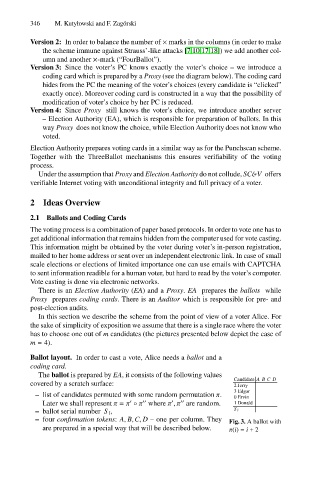
                          Ballot layout. In order to cast a vote, Alice needs a ballot and a
                          coding card.
                            The ballot is prepared by EA, it consists of the following values
                                                                                  Candidate AB C D
                          covered by a scratch surface:                           2 Jerry
                                                                                  3 Edgar
                           – list of candidates permuted with some random permutation π.  0Ervin


                             Later we shall represent π = π ◦ π where π ,π are random.  1 Donald

                           – ballot serial number S l ,                           S l
                           – four confirmation tokens: A, B,C, D – one per column. They  Fig. 3. A ballot with
                             are prepared in a special way that will be described below.  π(i) = i + 2

