


Page 369 - Towards Trustworthy Elections New Directions in Electronic Voting by Ed Gerck (auth.), David Chaum, Markus Jakobsson, Ronald L. Rivest, Peter Y. A. Ryan, Josh Benaloh, Miroslaw Kutylowski, Ben Adida ( (z-lib.org (1)
P. 369
361
                                                                 Securing Optical-Scan Voting


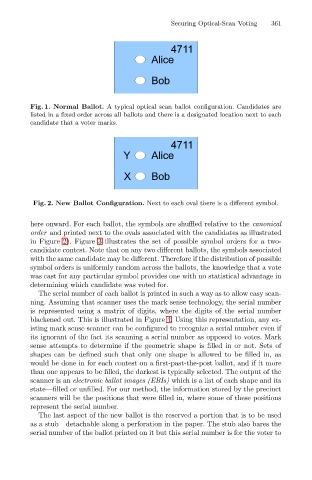
                          Fig. 1. Normal Ballot. A typical optical scan ballot configuration. Candidates are
                          listed in a fixed order across all ballots and there is a designated location next to each
                          candidate that a voter marks.


                           Fig. 2. New Ballot Configuration. Next to each oval there is a different symbol.


                          here onward. For each ballot, the symbols are shuffled relative to the canonical
                          order and printed next to the ovals associated with the candidates as illustrated
                          in Figure 2). Figure 3 illustrates the set of possible symbol orders for a two-
                          candidate contest. Note that on any two different ballots, the symbols associated
                          with the same candidate may be different. Therefore if the distribution of possible
                          symbol orders is uniformly random across the ballots, the knowledge that a vote
                          was cast for any particular symbol provides one with no statistical advantage in
                          determining which candidate was voted for.
                            The serial number of each ballot is printed in such a way as to allow easy scan-
                          ning. Assuming that scanner uses the mark sense technology, the serial number
                          is represented using a matrix of digits, where the digits of the serial number
                          blackened out. This is illustrated in Figure 4. Using this representation, any ex-
                          isting mark sense scanner can be configured to recognize a serial number even if
                          its ignorant of the fact its scanning a serial number as opposed to votes. Mark
                          sense attempts to determine if the geometric shape is filled in or not. Sets of
                          shapes can be defined such that only one shape is allowed to be filled in, as
                          would be done in for each contest on a first-past-the-post ballot, and if it more
                          than one appears to be filled, the darkest is typically selected. The output of the
                          scanner is an electronic ballot images (EBIs) which is a list of each shape and its
                          state—filled or unfilled. For our method, the information stored by the precinct
                          scanners will be the positions that were filled in, where some of these positions
                          represent the serial number.
                            The last aspect of the new ballot is the reserved a portion that is to be used
                          as a stub—detachable along a perforation in the paper. The stub also bares the
                          serial number of the ballot printed on it but this serial number is for the voter to

