


Page 97 - Towards Trustworthy Elections New Directions in Electronic Voting by Ed Gerck (auth.), David Chaum, Markus Jakobsson, Ronald L. Rivest, Peter Y. A. Ryan, Josh Benaloh, Miroslaw Kutylowski, Ben Adida ( (z-lib.org (1)
P. 97
A Secure Architecture for Voting Electronically (SAVE)
                                                                                             89
                             ing algorithm, may provide public verifiability.
                              The SAVE Architecture
                          4  numbers may help ameliorate this attack, and combined with a secure hash-
                          Our aim is to outline the architecture and principles of the SAVE system, rather
                          an describe in detail its implementation. The architectural overview will il-
                          lustrate the improvements and advantages over existing paper and electronic
                          systems.
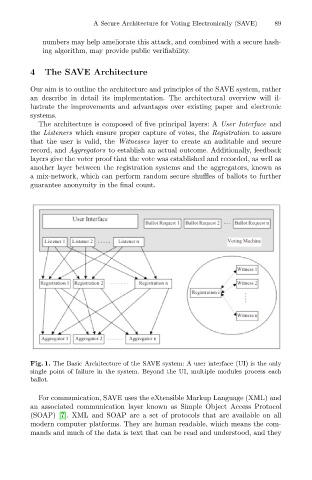
                            The architecture is composed of five principal layers: A User Interface and
                          the Listeners which ensure proper capture of votes, the Registration to assure
                          that the user is valid, the Witnesses layer to create an auditable and secure
                          record, and Aggregators to establish an actual outcome. Additionally, feedback
                          layers give the voter proof that the vote was established and recorded, as well as
                          another layer between the registration systems and the aggregators, known as
                          a mix-network, which can perform random secure shuffles of ballots to further
                          guarantee anonymity in the final count.


                          Fig. 1. The Basic Architecture of the SAVE system: A user interface (UI) is the only
                          single point of failure in the system. Beyond the UI, multiple modules process each
                          ballot.

                            For communication, SAVE uses the eXtensible Markup Language (XML) and
                          an associated communication layer known as Simple Object Access Protocol
                          (SOAP) [7]. XML and SOAP are a set of protocols that are available on all
                          modern computer platforms. They are human readable, which means the com-
                          mands and much of the data is text that can be read and understood, and they

