


Page 27 - Mliner_ProfessionalPortfolio
P. 27
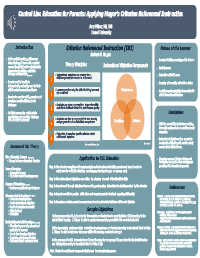
Central Line Education for Parents: Applying Mager’s Criterion Referenced Instruction
Amy Mliner, RN, BSN
Drexel University
Introduction Criterion Referenced Instruction (CRI) Nature of the Learner
Robert F. Mager
● In the pediatric setting, children are ● Parents of children needing a CVL at home
often discharged home with a central Theory Principles
venous line (CVL) for the administration Instructional Objective Components ● Adult learners
of parenteral nutrition, antibiotic
therapy, and hydration (Wall, 2013) • Instructional objectives are created for a ● Unfamiliar with CVL care
1 skill/competency that needs to be learned
● Parents need to be able to ● Learning of necessity, rather than choice
independently and safely care for their
child’s central venous line at home • Learners practice only the skills that they have not Performance ● Possibly experiencing high stress related to
2 yet mastered child’s illness/hospitalization
● In order to care for a CVL, parents must
develop a specific skillset prior to
discharge • Students are given opportunities to practice skills
3 and obtain feedback related to performance quality
● Pediatric nurses play a vital role in Conclusion
coordinating and providing discharge
CVL education to parents • Students are free to sequence their own learning Conditions Criterion
4 and progress based on individual competence ● With the use of CVLs in the home setting,
there will continue to be a need for parent
education.
• Evaluation is based on specific criterion stated
5 within each objective ● Instructional objectives allow parents to
(Mager, 1997) develop the skills they will need to safely
(Mager, 1997) & (Kearsley, 2016)
Essence of the Theory care for their child at home.
View of Learning Process: (Mager, 1997) Application to CVL Education ● Educators can use Criterion Referenced
- Change in learner in desired direction Instruction as a guide when creating and
Step 1: The educator completes a thorough analysis and determines what skills parents need learn in order to providing CVL education to parents.
Locus of Learning:
- External to learner safely care for a CVL (Ex: flushing, cap changes, dressing changes, emergency care)
- Educators control learning process
Step 2: Clear instructional objectives are written, by educator, for each of the identified skills
Purpose of Education: (Mager, 1997) Step 3: Parents work through objectives however they prefer, using instructional materials provided by the educator
- Produce a specific change in learner References
Step 4: Parents are able to practice skills often and educators provide feedback regarding skill quality
Educator’s Role in Teaching: (Mager, 1997) Candela, L. (2016). Theoretical foundations of teaching
- Determine learning needs and learning. In D.M. Billings & J.A. Halstead,
- Create instructional objectives Step 5: Educators evaluate parents for competence based on the stated criterion within each objective Teaching in nursing: A guide for faculty (5th ed.) (pp
- Provide instructional materials Sample Objectives 211-229). St. Louis, MO: Elsevier.
- Offer feedback Kearsley, G. (11/6/2016). The theory into practice
- Evaluation database. Retrieved from
In the presence of an RN, independently demonstrate on Chester how to correctly flush a CVL (according to the http://www.instructionaldesign.org/theories/criterion-
criteria listed in policy 2.24) and be able to explain when and why your child’s CVL needs to be flushed referenced.html
Manifestations in Adult Learning: (Candela, 2016)
- Education is personally relevant and Mager, R.F. (1997). Preparing instructional objectives: A
applicable to learners Without prompting, perform a sterile, central line dressing change on Chester (according to the criteria listed in Policy critical tool in the development of effective instruction.
- Use of clear learning objectives 2.24) and be able to state how often your child’s CVL dressing needs to be changed Atlanta, GA: Center for Effective Performance.
- Evaluation criteria is well stated
- Self-paced based on learner need In the presence of an RN, demonstrate on Chester the steps for emergency CVL care when the line is both broken Wall, J. (2013). Central vascular access device guidelines
and dislodged (according to the criteria listed in Policy 2.24) for pediatric home-based patients: Driving best
practices. Journal of the Association for Vascular
Access, 18(2), 103-113
Note. Chester is a unit based mannequin that is used for educational purposes.

