


Page 1490 - (ISC)² CISSP Certified Information Systems Security Professional Official Study Guide
P. 1490
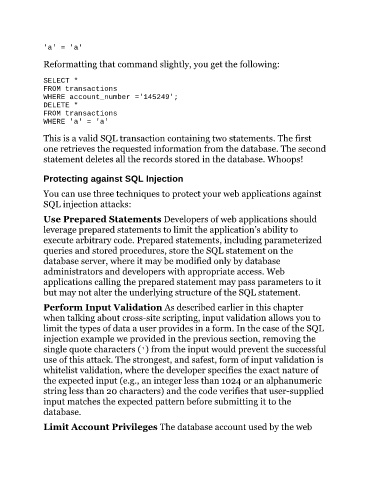
'a' = 'a'

               Reformatting that command slightly, you get the following:


               SELECT *
               FROM transactions
               WHERE account_number ='145249';
               DELETE *
               FROM transactions
               WHERE 'a' = 'a'

               This is a valid SQL transaction containing two statements. The first
               one retrieves the requested information from the database. The second
               statement deletes all the records stored in the database. Whoops!


               Protecting against SQL Injection

               You can use three techniques to protect your web applications against
               SQL injection attacks:

               Use Prepared Statements Developers of web applications should

               leverage prepared statements to limit the application’s ability to
               execute arbitrary code. Prepared statements, including parameterized
               queries and stored procedures, store the SQL statement on the
               database server, where it may be modified only by database
               administrators and developers with appropriate access. Web
               applications calling the prepared statement may pass parameters to it

               but may not alter the underlying structure of the SQL statement.

               Perform Input Validation As described earlier in this chapter
               when talking about cross-site scripting, input validation allows you to
               limit the types of data a user provides in a form. In the case of the SQL
               injection example we provided in the previous section, removing the
               single quote characters (') from the input would prevent the successful
               use of this attack. The strongest, and safest, form of input validation is

               whitelist validation, where the developer specifies the exact nature of
               the expected input (e.g., an integer less than 1024 or an alphanumeric
               string less than 20 characters) and the code verifies that user-supplied
               input matches the expected pattern before submitting it to the
               database.

               Limit Account Privileges The database account used by the web

