


Page 371 - (ISC)² CISSP Certified Information Systems Security Professional Official Study Guide
P. 371
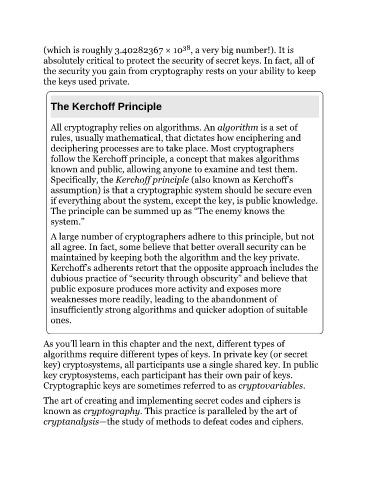
38
               (which is roughly 3.40282367 × 10 , a very big number!). It is
               absolutely critical to protect the security of secret keys. In fact, all of
               the security you gain from cryptography rests on your ability to keep
               the keys used private.


                  The Kerchoff Principle


                  All cryptography relies on algorithms. An algorithm is a set of
                  rules, usually mathematical, that dictates how enciphering and
                  deciphering processes are to take place. Most cryptographers
                  follow the Kerchoff principle, a concept that makes algorithms
                  known and public, allowing anyone to examine and test them.
                  Specifically, the Kerchoff principle (also known as Kerchoff’s
                  assumption) is that a cryptographic system should be secure even

                  if everything about the system, except the key, is public knowledge.
                  The principle can be summed up as “The enemy knows the
                  system.”

                  A large number of cryptographers adhere to this principle, but not
                  all agree. In fact, some believe that better overall security can be
                  maintained by keeping both the algorithm and the key private.
                  Kerchoff’s adherents retort that the opposite approach includes the

                  dubious practice of “security through obscurity” and believe that
                  public exposure produces more activity and exposes more
                  weaknesses more readily, leading to the abandonment of
                  insufficiently strong algorithms and quicker adoption of suitable
                  ones.


               As you’ll learn in this chapter and the next, different types of
               algorithms require different types of keys. In private key (or secret
               key) cryptosystems, all participants use a single shared key. In public

               key cryptosystems, each participant has their own pair of keys.
               Cryptographic keys are sometimes referred to as cryptovariables.

               The art of creating and implementing secret codes and ciphers is
               known as cryptography. This practice is paralleled by the art of
               cryptanalysis—the study of methods to defeat codes and ciphers.

